
A Practical Framework For Selecting Long-Acting Injectable Platforms Across Therapeutic, Product, And Delivery Constraints
By Amy C. Kauffman, Ph.D., Drug Product Development, Bristol Myers Squibb

Long-acting injectable (LAI) drug products have become an important focus of pharmaceutical innovation because they can reduce dosing burden, support adherence, and sustain therapeutic exposure over extended intervals. Once dominated by small molecule antipsychotics and hormonal therapies, the LAI landscape now spans a diverse set of modalities and technologies, including crystalline suspensions, polymeric micro- and nanosystems, in situ forming depots, implants, and lipid-based systems.1,2 Industry interest has increased as developers seek to translate complex therapeutic candidates into patient-centered products capable of delivering clinical benefit over weeks, months, or longer dosing intervals. The expanding range of platform technologies has broadened the development pathways available to formulation scientists while making platform selection more consequential.
Platform selection is increasingly complex because therapeutic modalities, delivery systems, and target product expectations have all diversified. A platform that is appropriate for one therapeutic context may be operationally burdensome, technically limiting, or clinically suboptimal in another. Successful LAI development therefore benefits from a fit-for-purpose approach that connects therapeutic needs with practical constraints.
The central challenge is not simply whether an LAI formulation can be designed but whether the selected platform can meet the combined technical, clinical, operational, and patient-centered requirements of the intended product. Because much of the literature emphasizes individual technologies rather than selection strategy, formulation teams may approach these decisions as a series of disconnected technical assessments. A structured framework can help teams compare options more consistently, identify critical risks earlier, and preserve flexibility while development assumptions are still evolving.
Step 1: Matching Payload Properties To Delivery Technologies
Alignment between the therapeutic asset and delivery platform is foundational to LAI development. More options do not necessarily simplify decision-making; rather, they increase the need to understand where each technology can provide meaningful value. Feasibility depends on factors including drug loading, potency, dose volume, physicochemical properties, toxicology profile, pharmacokinetics, pharmacodynamics, and release targets. Evaluation is most effective when it begins with the molecule and its performance requirements, rather than with preference for a familiar technology.
Dose requirement and potency are especially important early considerations.3 Highly potent compounds may be compatible with a broader range of platforms because lower doses reduce drug-loading demands, whereas high monthly or quarterly doses can constrain options through injection volume, drug loading, or depot geometry. Dosing interval should be evaluated in parallel because longer duration increases the burden on the delivery system.
Physicochemical properties represent another important decision point. Solubility, crystallization behavior, molecular weight, environmental sensitivity, and degradation pathways strongly influence platform compatibility. Poorly soluble molecules may be well suited to crystalline suspensions that rely on dissolution-controlled release, whereas highly soluble compounds may require polymer depots, molecular modification, or other approaches to extend exposure. Biologics, peptides, and nucleic acids add further constraints because biological activity must be preserved during manufacturing, storage, and administration.
These attributes should not be assessed independently: potency drives dose, dose drives loading, and loading helps determine whether the target interval is achievable. At this stage, the goal is to define the feasible design space and identify options that warrant further evaluation.
Step 2: Translating The Target Product Profile Into Selection Criteria
Before comparing technologies, organizations should define the product characteristics that will guide selection. Although many LAI technologies can provide prolonged exposure, they differ substantially in their ability to meet specific release, dose, administration, and stability targets. The target product profile (TPP) should translate clinical goals into measurable product requirements, creating an objective basis for early decisions.
Release kinetics are among the most important selection criteria. Some therapies require rapid attainment of therapeutic concentration followed by sustained maintenance, whereas others require delayed release, limited initial burst, or near zero-order delivery. The desired profile affects Cmax, onset, concentration fluctuation, and patient experience. Technologies unlikely to achieve the required pharmacokinetic profile should be deprioritized or reassessed early.
Dose and duration introduce additional practical constraints: as dose increases, drug loading, injection volume, and local tissue tolerance become more challenging. A platform suitable for a potent compound dosed in tens of milligrams may be impractical for therapies requiring hundreds of milligrams or more. Similarly, longer dosing intervals may require greater depot capacity, higher loading, more durable release mechanisms, or different delivery devices. The key is to balance patient convenience and adherence with formulation, administration, and manufacturing limits.
Stability targets should also be defined early. Shelf life, storage, and transport requirements can strongly influence platform feasibility, particularly for global or self-administered products. Platforms requiring extensive cold chain management or offering limited stability may be poorly aligned with commercial needs.
The most effective TPPs function as decision tools rather than aspirational product descriptions. These criteria should distinguish true requirements from negotiable attributes, helping teams identify where trade-offs are acceptable and where they would compromise the intended product profile. By distinguishing requirements from preferences, teams can narrow the option set before investing deeply in formulation optimization.
Step 3: Real-World Trade-Offs Between LAI Platforms
Once TPP-driven criteria have been established, candidate technologies can be evaluated against the intended product requirements. At this stage, no LAI platform should be assumed to be universally superior; each technology offers distinct advantages while introducing corresponding limitations. Consequently, selection becomes a question of contextual fit: which platform can meet the intended product profile with acceptable trade-offs?
Common trade-offs emerge across LAI development. For example, tunable systems such as PLGA microspheres and polymer depots can provide greater pharmacokinetic control but often require more complex manufacturing and characterization than suspension-based systems. Extending dosing intervals may also increase drug loading, viscosity, particle size, or depot volume, which can negatively affect syringeability, injection force, administration complexity, and patient experience. Emerging platforms may offer differentiation but often carry greater technical, regulatory, and manufacturing uncertainty than established technologies. These trade-offs are clearer when platforms are evaluated against defined clinical and product requirements rather than in isolation.
A high-dose small molecule illustrates this balance. For a therapy requiring several hundred milligrams every three months, a polymer depot may provide precise release control but also increase formulation complexity, manufacturing burden, and excipient requirements. Alternatively, selection of a crystalline suspension may offer prolonged exposure through slow dissolution and, depending on the molecule and process, a less complex manufacturing path. The decision is not which technology is superior, but which trade-offs best align with clinical objectives, patient experience, and commercial strategy.4,5
Many RNA therapeutics represent a different type of constraint. These molecules require facilitated intracellular delivery and protection from degradation, often necessitating lipid-based carrier systems despite stability, storage, and manufacturing challenges. In this case, platform choice is driven by the therapeutic modality itself: alternatives may offer advantages in other respects but may be unable to deliver the molecule to its site of action.6,7 Ultimately, these comparisons are most valuable when they make trade-offs explicit enough to support a defensible development decision.

Step 4: Injectability, Device, And Tissue Constraints
Delivery feasibility should be evaluated alongside formulation design, not after a platform has already been favored. An LAI may achieve the desired in vitro release profile yet fail if it cannot be administered reliably, comfortably, and reproducibly. Injectability, device compatibility, and tissue response should therefore be assessed early. Viscosity, particle size distribution, drug concentration, and suspension stability all influence injection force and device options, particularly as longer dosing intervals drive higher loading or more complex depot systems. Formulations with compelling release profiles may be impractical if they require excessive force or clinically unacceptable needle gauges. Therefore, injectability should be treated as a critical product attribute early in development, rather than as a late-stage screen after release performance has been established.
Device selection and formulation design are tightly linked. Prefilled syringes, autoinjectors, wearable systems, and other delivery formats impose constraints on volume, force, administration time, and container closure compatibility. Route of administration adds further complexity because intramuscular, subcutaneous, and intradermal tissues differ in anatomy, vascularity, immune response, and available depot space. Local tolerability and patient-to-patient tissue variability can affect absorption, performance, and acceptance, particularly for engineered depots designed for extended duration. Together, these considerations provide the basis for structured down-selection that evaluates feasibility, fit, and development risk in parallel.
Integrating The Framework: A Practical Decision Tree
The decision tree below translates these considerations into a sequence of gating questions for narrowing candidate platforms. Used prospectively, the framework can support transparent cross-functional discussion among formulation, clinical, device, manufacturing, and commercial stakeholders. The process should remain iterative but bounded by decision criteria that guide when to reassess, deprioritize nonviable options, or advance a lead platform.
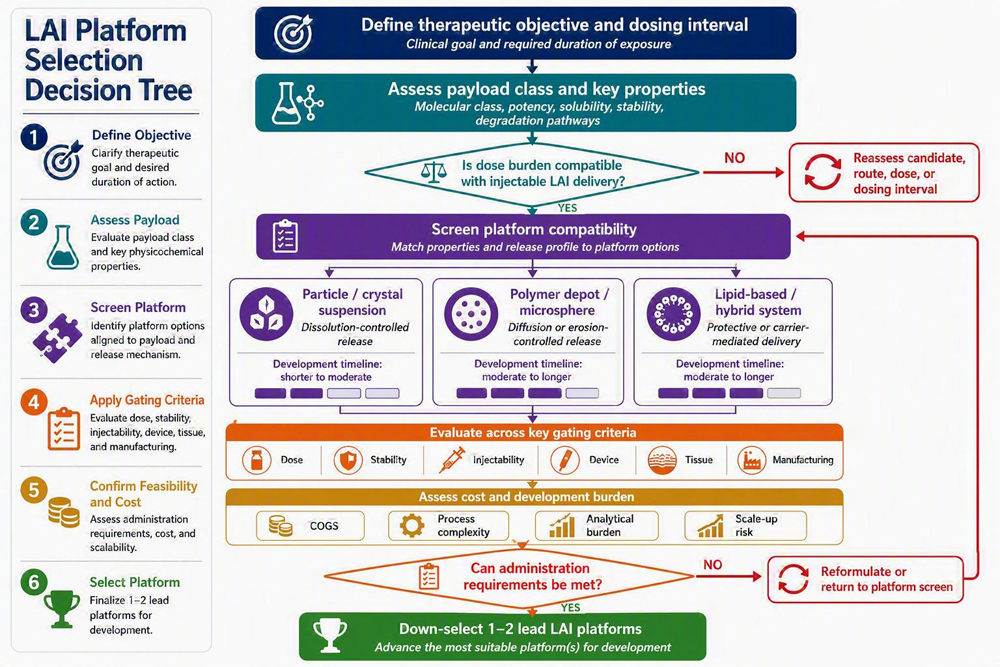
Figure 1. Framework for selecting and down-selecting LAI platforms based on molecule properties, product requirements, and development constraints. Figure created by the author of this article.
Common Pitfalls In LAI Platform Selection
Even with a structured framework, development teams can encounter recurring pitfalls that increase risk or drive late-stage redesign. Common examples include:
- overprioritizing release kinetics while underestimating injectability, device compatibility, and patient experience
- defaulting to familiar technologies rather than objectively assessing TPP fit
- underestimating tissue, device, manufacturing, scale-up, and cost constraints until late in development.
Considering these factors alongside clinical and formulation requirements can reduce the likelihood of late-stage redesign.
Future Directions
As LAI technologies evolve, selection decisions will increasingly move toward platform-device-product strategies that account for both technical feasibility and real-world use. Developers are extending long-acting strategies to emerging modalities, higher-dose products, and broader patient needs. Hybrid systems, including lipid-polymer platforms and combination depot strategies, may help address this complexity by integrating release control, payload protection, stability, and tissue targeting within a broader design space. This evolution will be particularly important for biologics, peptides, oligonucleotides, and RNA therapeutics, where platform feasibility is shaped not only by duration of exposure but also by molecular stability, delivery efficiency, and practical administration constraints.
Future selection frameworks should therefore move beyond technical feasibility alone and incorporate patient-centered considerations earlier, including setting of care, self-administration potential, device ease of use, dosing flexibility, and local tolerability. Modeling and simulation may further strengthen these decisions by connecting molecule properties, release behavior, tissue disposition, and clinical pharmacokinetics to support earlier risk assessment and more quantitative platform comparisons.
Conclusion
Effective LAI development depends on disciplined alignment among molecule properties, product goals, delivery feasibility, and patient needs. Robust LAI programs connect technology capability to therapeutic intent before formulation choices become difficult to reverse.
Applied early, structured evaluation can reduce late-stage compromises by helping teams distinguish technically attractive options from platforms that are clinically viable, manufacturable, and aligned with patient use.
References:
- Bauer, A., et al., Current State and Opportunities with Long-acting Injectables: Industry Perspectives from the Innovation and Quality Consortium "Long-Acting Injectables" Working Group. Pharm Res, 2023. 40(7): p. 1601–1631.
- Alidori, S., R. Subramanian, and R. Holm, Patient-Centric Long-Acting Injectable and Implantable Platforms─An Industrial Perspective. Mol Pharm, 2024. 21(9): p. 4238–4258.
- U.S. FDA, Guidance for Industry: Q8(R2) Pharmaceutical Development. 2009: Silver Spring, MD.
- D'Souza, S., et al., Development of Risperidone PLGA Microspheres. J Drug Deliv, 2014. 2014: p. 620464.
- Ravenstijn, P., et al., Pharmacokinetics, safety, and tolerability of paliperidone palmitate 3-month formulation in patients with schizophrenia: A phase-1, single-dose, randomized, open-label study. J Clin Pharmacol, 2016. 56(3): p. 330–9.
- Hou, X., et al., Lipid nanoparticles for mRNA delivery. Nature Reviews Materials, 2021. 6(12): p. 1078–1094.
- Jung, H.N., et al., Lipid nanoparticles for delivery of RNA therapeutics: Current status and the role of in vivo imaging. Theranostics, 2022. 12(17): p. 7509–7531.
About The Author:
 Amy C. Kauffman, Ph.D., is a Senior Principal Scientist in Sterile Product Development at Bristol Myers Squibb, specializing in advanced drug delivery systems, long-acting injectable therapies, and translational nanomedicine. Her work centers on translating innovative formulation and delivery concepts into practical, scalable solutions that bridge discovery and development. Prior to joining Bristol Myers Squibb, she held scientific and engineering roles at Corning Life Sciences and Yale University. Kauffman is an inventor and scientific innovator dedicated to transforming emerging drug delivery concepts into real-world therapeutic solutions.