
Antibody–Oligonucleotide Conjugates, Part 1: Approaching Your AOC Development Plan
By Robert Dream, consultant to the industry

Oligonucleotide therapeutics have established a new therapeutic paradigm in which disease biology can be modulated directly at the RNA level.1 Antisense oligonucleotides and siRNAs can selectively alter RNA processing, promote degradation of target transcripts, or induce RNA interference. Nevertheless, systemic delivery remains a major limitation for many oligonucleotide medicines. Chemical modification can improve nuclease resistance and pharmacokinetics, while conjugation to targeting ligands can alter tissue distribution; however, achieving efficient and selective delivery to extrahepatic tissues remains challenging.
AOCs address this problem by coupling an antibody to an oligonucleotide payload. The antibody provides molecular recognition and receptor-mediated cellular uptake, whereas the oligonucleotide provides the pharmacological activity. The resulting architecture can be represented conceptually as:
Antibody – linker/conjugation chemistry – oligonucleotide
The concept is related to an ADC but is fundamentally different from one. In a conventional ADC, the payload is usually a comparatively small molecule whose hydrophobicity, linker chemistry, and drug-to-antibody ratio (DAR) largely determine conjugate behavior. An oligonucleotide, in contrast, can contain tens of negative charges, substantial molecular mass, multiple chemical modifications, and sequence-dependent structural properties. Consequently, the oligonucleotide can dominate the charge, chromatographic behavior, mass-spectrometric response, and biological disposition of the conjugate.2,3.4
AOCs have moved from proof-of-concept studies into clinical development. A prominent early example was AOC 1001, an siRNA-containing conjugate directed toward transferrin receptor 1 (TfR1) for delivery to muscle, demonstrating the potential of receptor-mediated antibody delivery for extrahepatic RNA therapeutics.5
From a pharmaceutical-development perspective, the emergence of AOCs creates a particularly interesting CMC problem: the manufacturing process must control two fundamentally different molecular entities and then control the interface between them.
In this four-part article series, I’ll do a deep dive into developing and manufacturing AOCs. In this first article, I’ll cover defining your AOC development plan: the molecular architecture and the CMC consequence of “hybrid” identity and CMC development: defining the target product profile and clinical quality attributes of AOCs.
Molecular Architecture And The CMC Consequence Of “Hybrid” Identity
An AOC generally contains four functional components:
- Targeting antibody
- Conjugation site or reactive handle
- Linker
- Oligonucleotide payload
Each component contributes distinct CQAs.
The antibody determines target recognition, receptor binding, pharmacokinetics, Fc-related properties, aggregation behavior, and immunogenicity risk. The oligonucleotide determines sequence-specific pharmacology, chemical stability, nuclease resistance, intracellular activity, and potentially innate immune activation. The linker controls chemical stability during manufacturing and circulation while influencing intracellular release. Finally, the conjugation strategy determines the number and location of oligonucleotides attached to each antibody molecule.
This creates a key distinction between average oligonucleotide to antibody ratio (OAR) and OAR distribution. An AOC preparation having an average OAR of 2 may contain a mixture of unconjugated antibody, DAR/OAR 1, DAR/OAR 2, and higher-loaded species. Two products can therefore have the same average OAR but different distributions and potentially different biological properties.
The literature increasingly supports the importance of conjugation site and payload loading in determining pharmacokinetics, tissue delivery, and activity. Recent structure–activity studies have shown that antibody isotype, conjugation site, linker, oligonucleotide chemistry, and DAR can all influence AOC performance.6,7
This means that OAR distribution should be treated as a product quality characteristic rather than simply a process yield metric.
CMC Development: Defining The Target Product Profile
A rational AOC CMC program should begin with a target product profile (TPP) and a corresponding quality target product profile (QTPP). The QTPP should integrate molecular identity, biological function, purity, safety, stability, and manufacturability.
A representative QTPP may include:
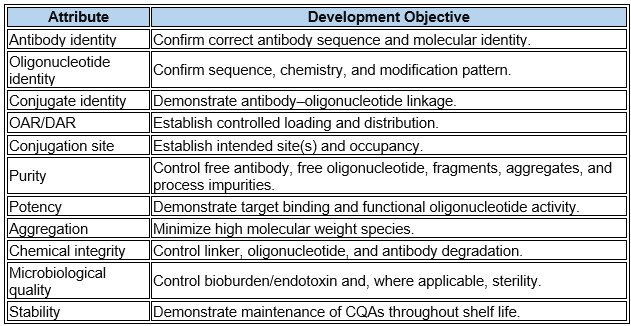
ICH Q6B establishes the general principle that specifications should focus on characteristics relevant to identity, purity, quantity, biological activity, and safety rather than attempting to use routine release testing as a substitute for complete product characterization.8,9,10 For AOCs, this distinction is particularly important. A comprehensive characterization package may require substantially more methods than the final release specification.
Critical Quality Attributes Of AOCs
Antibody-related CQAs
The antibody portion should generally be evaluated using a biologics-oriented analytical package, including:
- primary structure and identity
- molecular weight
- glycosylation
- charge heterogeneity
- aggregation
- fragmentation
- target binding
- Fc-related attributes, when applicable
- thermal stability
- concentration.
Depending on the conjugation strategy, additional CQAs include the availability and occupancy of engineered cysteines, lysines, glycan sites, or other reactive residues.

Oligonucleotide-related CQAs
The oligonucleotide component introduces an independent set of quality requirements:
- Sequence identity
- Full-length product percentage
- Deletion and insertion sequences
- Chemical modification pattern
- Stereochemical composition, where relevant
- Purity
- Residual solvents and reagents
- Residual protecting groups
- Aggregate or higher-order species
- End-group identity
- Nuclease stability
- Biological activity
The EMA's draft guideline on development and manufacture of oligonucleotides specifically addresses manufacturing, characterization, specifications, analytical control, conjugation, impurities, stereoisomers, deletion sequences, insertion sequences, and related quality considerations.8,9,10
Conjugate-related CQAs
The most distinctive CQAs are those created by the conjugation process:
- Average OAR/DAR
- OAR distribution
- Site occupancy
- Site distribution
- Free oligonucleotide
- Free antibody
- Linker integrity
- Conjugation efficiency
- Aggregation
- Fragmentation
- Charge distribution
- Biological activity of the intact conjugate
A useful conceptual framework is therefore:
Component CQAs + conjugation CQAs + functional CQAs = AOC control strategy
In Part 2 of this series, I’ll provide a deep dive into manufacturing; in part 3, I’ll delve into analytical control; and in part 4, I’ll discuss regulatory considerations and future directions.
References:
- Neutral Backbone Modifications Enhance the Pharmacokinetics and Biodistribution of Antibody–Oligonucleotide Conjugates with High Drug-to-Antibody Ratios. Journal of Medicinal Chemistry. 2026. This recent study illustrates the relationship among backbone chemistry, DAR, PK, biodistribution, and analytical characterization.
- Junutula JR, et al. Antibody-Oligonucleotide Conjugates: A Twist to Antibody-Drug Conjugates. Journal of Clinical Medicine. 2021;10(4):838. This review discusses AOC architectures, conjugation approaches, purification, and analytical characterization.
- Advances in the pharmaceutical development of antibody oligonucleotide conjugates. European Journal of Pharmaceutical Sciences. 2025;215:107292.
- Antibody-oligonucleotide conjugates: an emerging modality for precision RNA therapeutics. 2026 review discussing AOC development, site-specific conjugation, OAR, bioanalysis, manufacturing, and future challenges.
- AOC 1001 / MARINA clinical development literature. AOC 1001 represents an early clinical example of a TfR1-targeted antibody–siRNA conjugate designed for delivery to muscle in myotonic dystrophy type 1.
- Structure–Activity Relationship of Antibody–Oligonucleotide Conjugates: Evaluating Bioconjugation Strategies for Antibody–siRNA Conjugates for Drug Development. Journal of Medicinal Chemistry. 2024.
- Structure–Activity Relationship of Antibody–Oligonucleotide Conjugates: Evaluating Bioconjugation Strategies for Antibody–Phosphorodiamidate Morpholino Oligomer Conjugates for Drug Development. 2024.
- ICH Q6B: Specifications: Test Procedures and Acceptance Criteria for Biotechnological/Biological Products. FDA/ICH. Provides principles for characterization, specifications, identity, purity, quantity, and biological activity of biological products and conjugates.
- Guideline on the Development and Manufacture of Oligonucleotides. European Medicines Agency, draft guideline, 2024. Addresses synthetic oligonucleotide manufacturing, characterization, specifications, analytical control, impurities, and conjugation.
- ICH Q11: Development and Manufacture of Drug Substances. International Council for Harmonisation. Provides principles for process understanding, impurity control, and drug-substance manufacturing development.
About The Author:
 Robert Dream is a recognized industry leader with over 35 years of experience in the life sciences sector, including executive leadership roles. He has successfully led projects, optimized processes, and scaled products by leveraging operational excellence and deep technological expertise. Business-minded and strategically focused, Dream brings functional knowledge across manufacturing, supply chain, and regulatory domains. His background includes extensive hands-on and senior executive experience in therapeutic biotechnology and biological product manufacturing at world-leading organizations. A prolific contributor to the industry, Dream has authored numerous articles, industry guidances, and delivered many presentations.