
Comparing Advanced Modality Needs, Part 1: Manufacturing
By Robert Dream, consultant to the industry

The biopharmaceutical industry is increasingly characterized by therapeutic modalities that extend beyond conventional small molecules and recombinant biologics. Antibody-drug conjugates (ADCs), antibody-oligonucleotide conjugates (AOCs), advanced therapy medicinal products (ATMPs), cell and gene therapies (CGTs), and unconjugated oligonucleotide therapeutics represent distinct but increasingly interconnected approaches to precision medicine. Each modality offers important opportunities for addressing diseases that have historically been difficult to treat, but each also introduces unique manufacturing, regulatory, commercial, patient, payer, and healthcare-provider considerations.
ADCs have relatively mature clinical and commercial pathways but require sophisticated conjugation and analytical control strategies. AOCs combine the manufacturing and regulatory complexities of antibodies and nucleic acids and remain comparatively immature. ATMPs and CGTs can provide potentially durable or curative benefits but create substantial challenges involving individualized manufacturing, logistics, long-term follow-up, healthcare infrastructure, and reimbursement of high up-front costs. Oligonucleotide therapeutics have increasingly established regulatory precedents and potentially scalable synthetic manufacturing, although sequence-specific development, delivery, immunogenicity, tissue targeting, and manufacturing sustainability remain important considerations. Across modalities, successful commercialization increasingly depends not only on clinical efficacy but also on manufacturing robustness, evidence generation, health technology assessment, reimbursement design, patient selection, provider preparedness, and real-world outcome measurement. A modality-specific but integrated approach to development and market access is therefore required.
These technologies differ particularly in the relationship between the drug substance and the manufacturing process. For conventional drugs, manufacturing consistency is generally evaluated through control of a chemically defined molecule. For biologics and conjugates, structural heterogeneity can become an important critical quality consideration. For cell and gene therapies, the manufacturing process can be inseparable from product characteristics because living cells, vectors, or genetically modified biological systems may be inherently variable. FDA guidance issued in 2026 continues to emphasize the need for product-specific and life-cycle-oriented CMC (chemistry, manufacturing, and controls) approaches for cellular and gene therapies, while recognizing regulatory flexibility where appropriate.1,2
This two-part article series comparatively evaluates these five modalities across the product life cycle. In this first article, I’ll do a deep dive on manufacturing considerations and the implications for developers. In the upcoming second article of the series, I’ll delve into regulatory and market access considerations.
Overview Of The Five Modalities
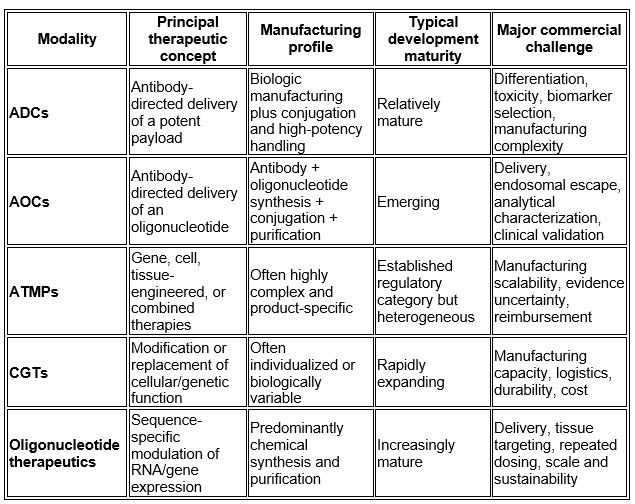
Table 1: Comparative characterization of the modalities
The categories are not mutually exclusive. A product may simultaneously be an ATMP and a CGT, for example. Similarly, an AOC is conceptually related to both ADCs and oligonucleotide therapeutics. The distinctions in this two-part article series therefore reflect the dominant development and commercialization characteristics rather than rigid taxonomic boundaries.
Manufacturing Considerations
Antibody-Drug Conjugates
ADCs are structurally composed of three major components: an antibody, a linker, and a pharmacologically active payload. Their manufacturing process consequently combines conventional monoclonal-antibody production with chemical conjugation and specialized handling of highly potent compounds.
One of the principal manufacturing challenges is control of conjugation heterogeneity. Depending on the conjugation strategy, individual antibody molecules can contain different numbers and locations of drug molecules. The resulting drug-to-antibody ratio (DAR), linker chemistry, conjugation site, aggregation, free payload, and product-related impurities can influence pharmacokinetics, efficacy, and toxicity.
Modern ADC development therefore relies heavily on quality-by-design principles, process characterization, analytical characterization, and life-cycle control. Recent reviews emphasize that conjugation is a critical manufacturing step requiring careful development, characterization, validation, and control.3
The manufacturing infrastructure for ADCs is nevertheless considerably more mature than that for AOCs or many CGTs. Antibody production can leverage established mammalian-cell platforms, while conjugation processes can be implemented in specialized facilities. The challenge is not simply producing the antibody or payload independently, but reliably producing a final conjugate with reproducible critical quality attributes.
Potent cytotoxic payloads also introduce occupational and facility-safety considerations. Manufacturing sites must address containment, operator exposure, environmental controls, and segregation of high-potency materials.
Antibody-Oligonucleotide Conjugates
AOCs present an even more complex manufacturing problem because they combine two technologically distinct modalities: an antibody and an oligonucleotide.
The manufacturing chain may include:
- antibody production
- oligonucleotide synthesis
- chemical modification of the oligonucleotide
- linker synthesis
- antibody functionalization
- conjugation
- removal of unconjugated components
- purification
- characterization of conjugation distribution
- and potency and stability testing.
AOCs therefore inherit some manufacturing challenges from both ADCs and oligonucleotide therapeutics. Recent reviews identify structural complexity, linker selection, conjugation strategy, purification, analytical characterization, and critical-quality-attribute control as major challenges.4–6
An additional issue is that conventional analytical approaches developed for antibodies or oligonucleotides independently may not fully characterize the final conjugate. Developers may need orthogonal analytical methods capable of determining conjugation efficiency, payload distribution, aggregation, free oligonucleotide, free antibody, molecular integrity, and biological activity.
AOCs also introduce a biological manufacturing problem beyond simple chemical characterization: The conjugate must successfully bind the intended target, undergo cellular internalization, traffic appropriately within the cell, and release or expose the oligonucleotide in a biologically active form. Endosomal escape is an important rate-limiting challenge for many AOC designs.5
Thus, AOCs currently represent a relatively high-risk manufacturing modality, although their modular architecture creates the possibility of platform manufacturing strategies in the future.
Advanced Therapy Medicinal Products
ATMP manufacturing differs fundamentally from traditional pharmaceutical manufacturing. In the European Union, ATMPs include gene therapy medicinal products, somatic cell therapy medicinal products, tissue-engineered products, and certain combined ATMPs.7
For cell-based products, manufacturing may involve:
- donor or patient material collection
- cell isolation
- activation
- genetic modification
- expansion
- differentiation
- purification
- formulation
- cryopreservation
- and final product release.
Autologous products are particularly challenging because the manufacturing process may involve an individual patient's own cells. Consequently, the "batch size" can approach one patient.
Gene therapies introduce additional manufacturing challenges related to vector production, potency, identity, purity, genomic safety, and consistency. The FDA's CMC guidance for human gene therapy products emphasizes the need to demonstrate identity, quality, purity, strength, and potency.8
A key problem is comparability. If a manufacturing process changes during development, demonstrating that the post-change product remains sufficiently comparable can be difficult. The European Medicines Agency has issued specific guidance addressing comparability for ATMPs following manufacturing changes or introduction of additional manufacturing sites.9
Cell And Gene Therapies
CGT manufacturing is characterized by biological variability, logistical complexity, and frequently limited scalability. Recent literature identifies donor-to-donor variability, contamination risk, vector-production limitations, genomic-safety concerns, and cold-chain instability among important manufacturing challenges.10
For autologous cell therapies, the manufacturing chain can be described as:
patient → collection → transportation → manufacturing → quality testing → release → transportation → treatment center → patient.

Any failure along this chain can delay or prevent treatment.
This creates a fundamental difference from conventional pharmaceutical manufacturing. A manufacturer of tablets can produce inventory in anticipation of demand. An autologous cell therapy manufacturer may instead have to coordinate production around individual patient schedules and biological starting material.
Allogeneic cell therapies could potentially overcome some of these limitations by allowing larger-scale production of standardized cell banks. However, they introduce other challenges, including immune compatibility, graft-versus-host disease, host rejection, persistence, and genetic stability.
Oligonucleotide Therapeutics
Oligonucleotides are generally produced through chemical synthesis, commonly using solid-phase phosphoramidite chemistry. Manufacturing involves iterative nucleotide coupling, deprotection, cleavage, purification, and analytical characterization.
The technology is relatively modular compared with cell and gene therapy manufacturing, but large-scale production creates significant challenges. Recent work notes that conventional solid-phase approaches face limitations involving scalability, sustainability, reagent consumption, and waste generation as demand increases.11
The pharmaceutical industry therefore faces a dual requirement: maintain highly controlled production of increasingly sophisticated modified oligonucleotides while developing more efficient and sustainable manufacturing processes.
Compared with CGTs, however, oligonucleotide manufacturing has a major commercial advantage: It can potentially generate conventional pharmaceutical inventory rather than patient-specific product.
Cross-Modality Comparison
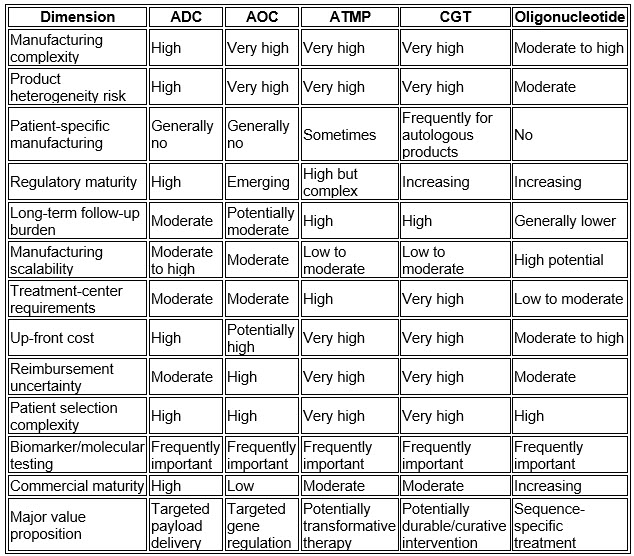
Table 2: Comparative evaluation
Strategic Implications For Developers
The comparison suggests that companies cannot use a single development strategy across these modalities.
For ADC Developers
The principal strategic priorities should be:
- differentiated target biology
- optimized payload and linker
- reproducible conjugation
- robust analytical characterization
- patient-selection strategy
- toxicity management
- and competitive positioning against increasingly sophisticated ADCs.
For AOC Developers
The greatest priorities are likely to be:
- demonstrating superior intracellular delivery
- solving endosomal escape
- establishing scalable conjugation
- defining critical quality attributes
- demonstrating differentiated clinical efficacy
- developing reliable pharmacodynamic biomarkers
- and creating manufacturing platforms that reduce cost.
For ATMP/CGT Developers
Success requires integration of:
- manufacturing early in development
- supply-chain planning
- treatment-center qualification
- long-term safety systems
- patient identification
- reimbursement strategy
- evidence generation
- provider training
- and financial-risk mitigation.
The manufacturing strategy should therefore be designed concurrently with clinical development rather than treated as a late-stage activity.
For Oligonucleotide Developers
The principal strategic priorities include:
- sequence and target validation
- tissue-specific delivery
- chemical modification
- minimizing off-target and immune effects
- scalable synthesis
- purification efficiency
- sustainable manufacturing
- and demonstrating clinical advantages over existing therapeutic approaches.
Comparing Modality Maturity
ADCs, AOCs, ATMPs, CGTs, and oligonucleotide therapeutics represent different stages and expressions of the transition toward precision and molecular medicine.
ADCs currently provide the most commercially mature example of a sophisticated conjugated therapeutic platform. Their major challenges involve manufacturing heterogeneity, toxicity, patient selection, and competitive differentiation.
AOCs are technologically promising but less mature. They combine the complexities of antibodies and oligonucleotides and must overcome challenges involving conjugation, intracellular trafficking, endosomal escape, analytical characterization, and clinical validation.
ATMPs and CGTs offer the greatest potential for durable or transformative outcomes but also present the greatest operational complexity. Manufacturing, logistics, provider infrastructure, long-term follow-up, and reimbursement are integral components of their clinical and commercial success.
Oligonucleotide therapeutics occupy an intermediate position. Their manufacturing infrastructure is comparatively scalable, regulatory experience is expanding, and sequence-specific pharmacology offers substantial therapeutic flexibility. However, delivery, tissue targeting, immunogenicity, manufacturing sustainability, and long-term clinical differentiation remain important challenges.
References
- U.S. Food and Drug Administration. Frequently Asked Questions—Developing Potential Cellular and Gene Therapy Products: Guidance for Industry. August 2026.
- U.S. Food and Drug Administration. Chemistry, Manufacturing, and Controls Flexibilities for Developing Human Cellular and Gene Therapy Products for a Biologics License Application: Guidance for Industry. May 2026.
- Meng Li, Xueyu Zhao, Chuanfei Yu, and Lan Wang. Published in Pharmaceutical Research (Volume 41, pages 419–440) Antibody Drug Conjugate Overview: A State-of-the-Art Manufacturing Process and Control Strategy. Pharmaceutical Research. 2024.
- Antibody-Oligonucleotide Conjugates: A Twist to Antibody-Drug Conjugates. Journal of Clinical Medicine. 2021;10:838. doi:10.3390/jcm10040838.
- Jinlan Jiao, Yun Qian, Yinhua Lv, Wenqian Wei, Yongxuan Long, Xiaoling Guo, Anya Buerliesi, Jiahui Ye, Hao Han, Jinbo Li, Yun Zhu, Weijie Zhang, Overcoming Limitations and Advancing the Therapeutic Potential of Antibody-Oligonucleotide Conjugates: Current Status and Future Perspectives. 2024. https://www.sciencedirect.com/science/article/pii/S1043661824004146 https://www.sciencedirect.com/science/article/pii/S1043661824004146
- Advances in the Pharmaceutical Development of Antibody-Oligonucleotide Conjugates. European Journal of Pharmaceutical Sciences. 2025;107292. doi:10.1016/j.ejps.2025.107292.
- European Medicines Agency. Advanced Therapy Medicinal Products: Overview. European Medicines Agency. https://www.ema.europa.eu/en/human-regulatory-overview/advanced-therapy-medicinal-products-overview
- U.S. Food and Drug Administration. Chemistry, Manufacturing, and Control (CMC) Information for Human Gene Therapy Investigational New Drug Applications: Guidance for Industry. January 2020.
- European Medicines Agency. Questions and Answers on Comparability Considerations for Advanced Therapy Medicinal Products (ATMP). EMA/CAT/499821/2019.
- Rajath Samaga, Udisha Singh, Sachin Dattram Pawar, Department of Pharmaceutical Quality Assurance, Manipal College of Pharmaceutical Sciences, Manipal Academy of Higher Education, Manipal, India, Department of Pharmaceutical Biotechnology, Manipal College of Pharmaceutical Sciences, Manipal Academy of Higher Education, Manipal, India, Cell and Gene Therapies Manufacturing Challenges and Integrated Good Manufacturing Practices Solutions: A Lifecycle Perspective. 2026. https://analyticalsciencejournals.onlinelibrary.wiley.com/doi/pdfdirect/10.1002/bit.70361
- R Obexer, M Nassir, E R Moody, P S Baran, S L Lovelock, Modern Approaches to Therapeutic Oligonucleotide Manufacturing. Science. 2024. doi:10.1126/science.adl4015. https://pubmed.ncbi.nlm.nih.gov/38603508/
About The Author:
 Robert Dream is a recognized industry leader with over 35 years of experience in the life sciences sector, including executive leadership roles. He has successfully led projects, optimized processes, and scaled products by leveraging operational excellence and deep technological expertise. Business-minded and strategically focused, Dream brings functional knowledge across manufacturing, supply chain, and regulatory domains. His background includes extensive hands-on and senior executive experience in therapeutic biotechnology and biological product manufacturing at world-leading organizations. A prolific contributor to the industry, Dream has authored numerous articles, industry guidances, and delivered many presentations.