
Comparing Advanced Modality Needs, Part 2: Regulatory And Market Access
By Robert Dream, consultant to the industry

Biopharmaceutical innovation has expanded beyond conventional small molecule drugs and recombinant proteins to include advanced therapeutic modalities targeting specific cells, genes, and biological pathways. These include antibody-drug conjugates (ADCs), antibody-oligonucleotide conjugates (AOCs), advanced therapy medicinal products (ATMPs), cell and gene therapies (CGTs), and oligonucleotide therapeutics. Although these approaches offer opportunities to improve therapeutic precision and clinical outcomes, they differ considerably in their technological complexity, manufacturing scalability, regulatory requirements, commercial viability, and implications for healthcare delivery.
These differences arise from their distinct biological and technological characteristics. ADCs combine monoclonal antibodies with cytotoxic or other therapeutic payloads, whereas AOCs use antibody-mediated delivery of oligonucleotides. ATMPs encompass gene therapies, somatic cell therapies, tissue-engineered products, and certain combined products under the European regulatory framework. CGTs represent a broader category of cellular and genetic interventions, while oligonucleotide therapeutics include antisense oligonucleotides (ASOs), small interfering RNAs (siRNAs), and related nucleic-acid-based medicines. These differences influence development strategies, product characterization, manufacturing requirements, and regulatory pathways.
Regulatory challenges vary across modalities, particularly regarding quality control, product characterization, clinical evidence, and long-term safety monitoring. ATMPs and many CGTs require specialized regulatory oversight because of their biological complexity and potential long-term effects. ADCs and oligonucleotide therapeutics generally follow established medicinal product frameworks, although their specific characteristics introduce additional development and regulatory considerations. AOCs present further challenges associated with integrating antibody and nucleic-acid components. Moreover, differences between regional regulatory frameworks can complicate global development and market access.
Commercial viability is similarly influenced by manufacturing costs, production scalability, supply-chain requirements, market size, and competitive positioning. Treatment duration is particularly important: Oligonucleotide therapeutics often require repeated administration and recurring expenditure, whereas certain CGTs involve substantial up-front costs with the potential for long-lasting clinical benefits. These differences have significant implications for pricing, reimbursement, affordability, and long-term economic value.
Ultimately, the adoption of these therapies depends on the interconnected needs of patients, payers, providers, and healthcare systems. Patients prioritize efficacy, safety, accessibility, treatment burden, and quality of life. Payers must assess treatment costs against clinical benefits, durability, cost-effectiveness, budget impact, and uncertainty regarding long-term outcomes. Healthcare providers must also address infrastructure requirements, specialized expertise, treatment logistics, multidisciplinary coordination, and long-term patient monitoring. Collectively, these considerations influence treatment capacity, geographic availability, healthcare expenditure, and equitable patient access.
Regulatory Considerations
ADCs
ADCs have become sufficiently established that regulators now have modality-specific experience. In the United States, the FDA published final guidance on clinical pharmacology considerations for ADCs in 2024. The guidance addresses bioanalytical methods, dosing, exposure-response relationships, immunogenicity, intrinsic factors, heart rate-corrected QT interval (QTc) assessment, and drug-drug interactions.1
Regulatory assessment therefore requires understanding not only the antibody but also the conjugated product, released payload, metabolites, and exposure relationships.
A major regulatory consideration is whether traditional pharmacokinetic measures adequately describe the clinically relevant exposure. Total antibody, conjugated antibody, free payload, and active metabolites may have different relationships with efficacy and toxicity.
Companion diagnostics may also be relevant when efficacy depends strongly on target expression.
AOCs
AOCs do not yet possess the same regulatory maturity as ADCs. Regulators will need to evaluate a product that simultaneously incorporates antibody pharmacology, nucleic-acid pharmacology, linker chemistry, intracellular trafficking, and potentially novel mechanisms of gene regulation.
This creates questions regarding:
- appropriate characterization of the final drug product
- pharmacokinetic and pharmacodynamic measurements
- tissue distribution
- immunogenicity
- target-mediated disposition
- oligonucleotide metabolites
- off-target gene effects
- antibody-related safety
- linker stability
- and long-term effects of gene modulation.
Consequently, AOC regulatory development is likely to require substantial product-specific interaction with regulatory agencies.
ATMPs
The European Union has an established regulatory framework for ATMPs under Regulation (EC) No. 1394/2007. The European Medicines Agency's (EMA's) framework covers gene therapies, somatic cell therapies, tissue-engineered products, and combined ATMPs.2
The EMA's 2025 guideline for investigational ATMPs provides current guidance on quality, nonclinical, and clinical requirements for exploratory and confirmatory trials.13
ATMP development can be especially challenging because traditional randomized clinical trials may be difficult in rare diseases. Small populations, disease heterogeneity, ethical considerations, and rapidly progressive conditions can limit the feasibility of conventional trial designs.
Long-term safety monitoring is also important. For gene therapies, the FDA recommends long-term follow-up when the biological characteristics of the therapy create the possibility of delayed adverse events.3
Cell And Gene Therapies
CGTs require extensive regulatory consideration of both the therapeutic mechanism and manufacturing process.
Important regulatory issues include:
- vector identity and purity
- replication-competent viral contaminants
- genomic integration
- off-target editing
- tumorigenicity
- persistence
- immune responses
- potency assays
- manufacturing consistency
- and long-term follow-up.
The FDA's 2026 CGT guidance emphasizes multidisciplinary considerations spanning CMC (chemistry, manufacturing, and controls), pharmacology/toxicology, clinical development, and clinical pharmacology.4
An important recent regulatory trend is movement toward greater use of platform knowledge and manufacturing experience. The FDA has also explored mechanisms through which established platform knowledge may reduce redundant development work for certain gene therapies.5
Oligonucleotide Therapeutics
Oligonucleotide therapeutics have a comparatively well-developed regulatory framework. The FDA's 2024 clinical pharmacology guidance addresses QTc prolongation, immunogenicity, hepatic and renal impairment, and drug-drug interactions.6
However, oligonucleotides remain pharmacologically distinct from conventional small molecules. Important considerations include tissue distribution, chemical modifications, protein binding, cellular uptake, metabolism, renal clearance, immune stimulation, and sequence-specific or off-target effects.
The regulatory framework is consequently becoming increasingly specialized while remaining sufficiently flexible to accommodate ASOs, siRNAs, and related technologies.
Market And Commercial Considerations
ADC Market Characteristics
ADCs currently possess the strongest commercial maturity among the conjugated modalities considered here. Their primary market has been oncology, where targeted delivery of potent payloads can potentially improve therapeutic index.
Commercial differentiation increasingly depends on:
- target selection
- biomarker strategy
- payload class
- linker technology
- drug-to-antibody ratio (DAR) and conjugation strategy
- efficacy in earlier lines of therapy
- combination opportunities
- safety
- resistance mechanisms
- manufacturing cost.
The rapid evolution of ADCs means that future competition is likely to depend less on simply having an ADC and more on achieving clinically meaningful differentiation. Recent reviews describe ADCs as among the fastest-growing anticancer therapeutic classes while emphasizing unresolved challenges in patient selection and toxicity management.7
AOC Market Characteristics
The AOC market remains considerably less mature. Commercial value depends heavily on whether targeted delivery can solve limitations associated with conventional oligonucleotides.
The central commercial proposition is therefore: Can an antibody deliver a nucleic-acid payload selectively enough to produce clinically meaningful efficacy that cannot be achieved economically with an unconjugated oligonucleotide?
AOCs could become particularly valuable in diseases where tissue penetration, cellular uptake, or target-cell specificity limits conventional oligonucleotide approaches.
However, the added antibody and conjugation manufacturing steps may increase cost. AOC developers will therefore need to demonstrate that improved targeting creates sufficient incremental clinical value.
ATMP And CGT Markets
ATMP and CGT markets differ from conventional pharmaceutical markets because treatment can be highly centralized. A product may be approved nationally but accessible only through a limited network of qualified treatment centers.
European evidence demonstrates that reimbursement and availability can vary substantially between countries despite centralized regulatory authorization. Studies have found differences in therapeutic-value assessments, market availability, reimbursement timing, and restrictions.8–10
Commercial success therefore requires more than regulatory approval. It requires an ecosystem consisting of:
- trained treatment centers
- manufacturing capacity
- logistics
- reimbursement mechanisms
- patient referral networks
- diagnostic infrastructure
- long-term follow-up
- data systems
- and financial arrangements.
This makes CGT commercialization partly a healthcare-infrastructure problem.

Oligonucleotide Therapeutics Market
Oligonucleotide therapeutics may have a more conventional commercial model because many are administered repeatedly and can be distributed through established pharmaceutical channels.
Nevertheless, market opportunities depend on the extent to which an oligonucleotide provides meaningful advantages over:
- small-molecule drugs
- monoclonal antibodies
- conventional RNA therapeutics
- existing ASOs or siRNAs
- and emerging gene-editing approaches.
The ability to rapidly design sequence-specific therapeutics is commercially attractive, particularly for genetically defined diseases. However, commercial scalability ultimately depends on manufacturing capacity and sustainable production. Recent research highlights the need for new synthesis and process-engineering approaches as oligonucleotide demand grows.11
Patient Considerations
Treatment Burden And Patient Experience
Patient experience across ADCs, AOCs, ATMPs, CGTs, and oligonucleotide therapeutics is shaped by administration routes, treatment frequency, safety profiles, clinical requirements, and monitoring needs. Treatment burden extends beyond dosing schedules to include pretreatment procedures, hospitalization, adverse effects, recovery time, travel, and long-term follow-up. Consequently, patient-centered assessment must consider both the immediate demands of treatment and its long-term impact on quality of life.
ADCs
ADCs generally follow established oncology treatment pathways, involving repeated intravenous administration in outpatient or hospital settings. Although their targeted design may improve therapeutic selectivity, payload-related toxicities remain important, including myelosuppression, peripheral neuropathy, ocular toxicity, and hepatotoxicity. Infusion reactions and cumulative adverse effects may also require dose modifications, supportive care, and additional monitoring. Thus, patient burden depends on treatment duration, toxicity management, and clinical monitoring, rather than infusion frequency alone.
AOCs
AOCs combine antibody-mediated cellular targeting with oligonucleotide-based gene modulation, potentially improving tissue-specific delivery and reducing exposure to nontarget tissues. These characteristics could improve tolerability and expand treatment opportunities for diseases with limited therapeutic options. However, their clinical advantages remain to be established. Administration frequency, immunogenicity, tolerability, tissue distribution, and long-term safety will determine their eventual impact on patient experience. Accordingly, their potential to reduce treatment burden remains promising but unproven.
ATMPs And CGTs
ATMPs and CGTs offer the potential for durable disease modification and, in selected indications, curative outcomes, potentially reducing the need for lifelong medication. However, their treatment pathways can be particularly demanding. Depending on the product, patients may require extensive eligibility assessments, genetic testing, cell collection, bridging therapy, conditioning regimens, and specialized hospitalization. Autologous cell therapies may also involve manufacturing delays and interim disease management.
Treatment-related complications, including cytokine release syndrome, neurotoxicity, infections, and organ toxicities, can further increase short-term burden. Additionally, certain gene therapies require prolonged safety surveillance, while treatment availability may be restricted to specialized centers, increasing travel and access challenges. Therefore, potential long-term benefits must be balanced against intensive treatment procedures, acute risks, and follow-up requirements.
Oligonucleotide Therapeutics
Oligonucleotide therapeutics enable targeted modulation of gene expression and may offer sustained pharmacological effects with less frequent administration in certain indications. However, treatment burden varies according to formulation and administration route. Subcutaneous and intravenous therapies generally require repeated injections or infusions, whereas intrathecal administration involves lumbar punctures and specialized clinical procedures. Adverse effects, including injection-site reactions, hepatic or renal toxicity, and thrombocytopenia, may necessitate ongoing monitoring. Furthermore, the need for repeated or chronic administration makes adherence and cumulative treatment demands important considerations.
Comparative Perspective
Patient burden differs substantially across these modalities. ADCs generally involve repeated administration and toxicity monitoring, whereas AOCs offer potential improvements in targeted delivery that require clinical validation. ATMPs and CGTs may provide durable therapeutic benefits but often involve intensive pretreatment, hospitalization, and long-term surveillance. Oligonucleotide therapeutics offer targeted gene modulation, with treatment burden largely dependent on administration route, dosing frequency, and tolerability.
Importantly, reduced dosing frequency does not necessarily equate to lower overall treatment burden. A comprehensive patient-centered assessment should balance treatment intensity, safety, convenience, therapeutic durability, quality of life, and accessibility. Ultimately, the value of these therapies depends not only on clinical efficacy but also on their ability to deliver meaningful benefits without imposing disproportionate demands on patients.
Payer And Health Technology Assessment Considerations
The Fundamental Difference: Recurring Cost Versus Up-Front Cost
One of the most important distinctions among these modalities is the timing of expenditure.
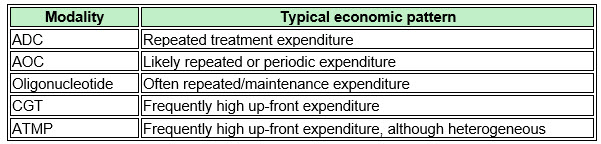
A CGT may have a high acquisition cost but potentially eliminate years of subsequent treatment. Consequently, conventional annual drug-budget analysis may undervalue its potential lifetime benefit.
Conversely, payers face uncertainty because durability may not be known at launch.
Health Technology Assessment
ATMPs create particularly difficult health technology assessment (HTA) problems because evidence at launch is often limited and long-term outcomes are uncertain.
Studies comparing European HTA decisions have identified uncertainty around comparative effectiveness, durability, cost-effectiveness, and therapeutic added value as recurring issues.12,13
Differences between regulatory approval and reimbursement are especially important. Regulatory agencies primarily determine whether benefits outweigh risks under an authorization framework. HTA organizations and payers additionally determine whether the incremental benefit is sufficient to justify the price within a particular healthcare budget. Therefore: regulatory approval ≠ reimbursement ≠ broad patient access.
This distinction applies to all modalities but is particularly important for ATMPs and CGTs.
Outcomes-Based Agreements
Outcomes-based agreements can link payment to patient outcomes rather than solely to product acquisition.
CMS's Cell and Gene Therapy Access Model illustrates this approach. The model allows participating states to use outcomes-based agreements for certain gene therapies for sickle cell disease, with payment arrangements linked to specified clinical outcomes.14
European policy research similarly supports outcomes-based approaches when uncertainty regarding long-term benefit makes conventional reimbursement difficult. However, the same literature cautions that complex agreements can create significant administrative burdens for payers and providers.15
The most effective reimbursement models are therefore likely to be those that balance:
- financial risk
- evidence uncertainty
- administrative simplicity
- patient access
- provider cash flow
- and long-term outcome measurement.
Provider Considerations
ADCs
Providers administering ADCs generally work within established oncology infrastructure. However, ADCs can require:
- infusion capacity
- laboratory monitoring
- toxicity management
- biomarker testing
- specialized pharmacy handling
- and multidisciplinary oncology expertise.
As ADC use expands into earlier treatment settings and combinations, provider familiarity with adverse-event management becomes increasingly important.
AOCs
AOCs would likely initially be administered through specialized centers. Providers may need to understand both biologic and nucleic-acid pharmacology.
If AOCs demonstrate major advances in rare diseases, specialized centers may become important for diagnosis, molecular testing, treatment selection, administration, and long-term monitoring.
ATMPs And CGTs
Provider burden is greatest for many CGTs. Treatment centers may need capabilities for:
- patient eligibility assessment
- leukapheresis or tissue collection
- cell processing
- cryogenic storage
- chain-of-identity management
- conditioning therapy
- infusion
- management of cytokine release syndrome
- immune effector cell-associated neurotoxicity
- infection prevention
- intensive monitoring
- and long-term follow-up.
ATMPs can therefore require reconfiguration of hospital and pharmaceutical workflows. European literature has specifically identified the need to reorganize hospital and pharmaceutical circuits around these complex products.16
The provider is not simply administering a drug; the provider may be operating part of the product's manufacturing and delivery ecosystem.
Oligonucleotide Therapeutics
Oligonucleotide therapies generally impose a lower infrastructure burden than CGTs. However, provider responsibilities may include:
- injection administration
- laboratory monitoring
- renal/hepatic assessment
- immunogenicity surveillance
- neurological monitoring where relevant
- and management of class-specific adverse effects.
This relatively conventional delivery infrastructure can provide an important commercialization advantage.
Future Outlook
The future of these modalities is likely to involve increasing convergence rather than continued separation.
ADCs are already evolving through new payload classes, site-specific conjugation, bispecific targeting, and increasingly sophisticated linker technologies. AOCs represent another step toward combining targeted protein recognition with nucleic-acid-based gene regulation.
Oligonucleotide technologies may also increasingly intersect with antibodies, nanoparticles, peptides, and other delivery systems. This convergence could create therapeutic platforms capable of selectively modulating genes within defined cell populations.
Similarly, cell and gene therapy manufacturing is moving toward automation, closed systems, decentralized manufacturing, and potentially allogeneic platforms. Improvements in manufacturing may ultimately reduce both cost and patient waiting time.
The regulatory environment is also evolving. The FDA's 2026 CGT guidance illustrates a movement toward more flexible, knowledge-based approaches while retaining requirements for product quality and patient safety.4,5 In Europe, ATMP regulation and HTA processes are similarly evolving as national systems attempt to reconcile centralized authorization with decentralized reimbursement and healthcare delivery.8–10
The economic question will become increasingly important. The central issue for advanced therapeutics is not simply whether a therapy works, but whether the healthcare system can identify appropriate patients, deliver it safely, pay for it sustainably, and measure whether the promised value materializes.
Strategic Implications For Advanced Therapeutic Development
Across all five modalities, the traditional model of pharmaceutical development — discover, manufacture, obtain regulatory approval, and then address commercialization — is increasingly inadequate. Successful development requires manufacturing, regulatory strategy, clinical evidence, patient access, provider readiness, and reimbursement planning to be integrated from the earliest stages of development.
The ultimate competitive advantage of an advanced therapeutic will therefore not be determined solely by molecular innovation. It will depend on the ability to translate molecular innovation into a product that can be manufactured reproducibly, approved efficiently, delivered safely, valued by payers, adopted by providers, and meaningfully improve patients' lives.
References
- U.S. Food and Drug Administration. Clinical Pharmacology Considerations for Antibody-Drug Conjugates: Guidance for Industry. March 2024.
- European Medicines Agency. Advanced Therapy Medicinal Products: Overview. European Medicines Agency.
- U.S. Food and Drug Administration. Long Term Follow-up After Administration of Human Gene Therapy Products: Guidance for Industry. January 2020.
- U.S. Food and Drug Administration. Frequently Asked Questions—Developing Potential Cellular and Gene Therapy Products: Guidance for Industry. August 2026.
- U.S. Food and Drug Administration. FDA Issues Draft Guidance to Help Accelerate Cell and Gene Therapies for Patients. June 2, 2026.
- U.S. Food and Drug Administration. Clinical Pharmacology Considerations for the Development of Oligonucleotide Therapeutics: Guidance for Industry. June 2024.
- Conilh L, Metrangolo V, Crescioli S, Reichert JM, Dumontet C. Navigating the clinical progress of antibody-drug conjugates: Emerging opportunities and remaining challenges. Cell. 2026. doi:10.1016/j.cell.2026.04.016.
- Gozzo L, Romano GL, Romano MF, et al. Health technology assessment of advanced therapy medicinal products: Comparison among 3 European countries. Frontiers in Pharmacology. 2021;12:755052. doi:10.3389/fphar.2021.755052.
- Ten Ham RMT, et al. Key considerations in the health technology assessment of advanced therapy medicinal products in Scotland, the Netherlands, and England. Value in Health. 2022;25(3):390–399. doi:10.1016/j.jval.2021.09.012.
- Financing and reimbursement of approved advanced therapies in several European countries. Value in Health. 2023.
- Modern Approaches to Therapeutic Oligonucleotide Manufacturing. Science. 2024. doi:10.1126/science.adl4015.
- Gonçalves E. Advanced therapy medicinal products: Value judgement and ethical evaluation in health technology assessment. European Journal of Health Economics. 2020;21(3):311–320. doi:10.1007/s10198-019-01147-x.
- European Medicines Agency. Guideline on Quality, Non-Clinical and Clinical Requirements for Investigational Advanced Therapy Medicinal Products in Clinical Trials. EMA/CAT/22473/2025.
- Centers for Medicare & Medicaid Services. Cell and Gene Therapy Access Model: Frequently Asked Questions. U.S. Department of Health and Human Services.
- Linking reimbursement to patient benefits for advanced therapy medicinal products and other high-cost innovations: Policy recommendations for outcomes-based agreements in Europe. 2024.
- Mebarki M, Madelaine I, Larghero J, de Jorna R. Advanced therapy medicinal products: Regulatory framework, hospital and pharmaceutical circuits in Europe and France. Thérapie. 2022;77(2):185–190. doi:10.1016/j.therap.2021.11.005.
About The Author:
 Robert Dream is a recognized industry leader with over 35 years of experience in the life sciences sector, including executive leadership roles. He has successfully led projects, optimized processes, and scaled products by leveraging operational excellence and deep technological expertise. Business-minded and strategically focused, Dream brings functional knowledge across manufacturing, supply chain, and regulatory domains. His background includes extensive hands-on and senior executive experience in therapeutic biotechnology and biological product manufacturing at world-leading organizations. A prolific contributor to the industry, Dream has authored numerous articles, industry guidances, and delivered many presentations.