
Does Drug Discovery Anticipate Delivery?

By Tom von Gunden, Chief Editor, Drug Delivery Leader
A while ago, when I became the inaugural chief editor on Drug Delivery Leader and shifted my attention from biopharma more broadly to drug delivery specifically, I had some decisions to make regarding scope of coverage. In terms of topic sets and focuses, I pondered, “What, exactly, are we or should we be declaring that drug delivery is? What does it contain? What’s in scope? What’s out of scope?”
Perhaps at the foundation of those foundational questions came this one: “When and where does drug delivery begin?”
Taking breadth and depth into consideration, I chose then to declare drug delivery as beginning at least after whatever might typically be bucketed under drug discovery. In other words, drug delivery begins at least no earlier than after a lead molecule has been identified. So, I set the beginning of drug delivery as formulation and dosing.
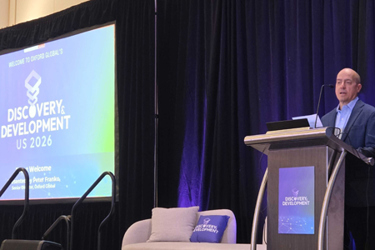
With that cognitive frame still firmly in mind, I recently made my way to the Discovery & Development US 2026 conference in San Diego, curious to see how the also promoted Formulation & Delivery component of the agenda might resonate with a crowd heavily comprising drug discovery professionals.
I was especially eager to determine what, if anything, a drug discoverer ponders about the ultimate delivery of an emerging drug substance or drug product.
Somewhat randomly and certainly not comprehensively, I encountered interesting takes on the following topics spanning concepts and conversations that helped bring discovery and delivery closer together:
- Evolving the Target Product Profile (TPP) in guiding development
- Leveraging nanoscale technology to formulate for challenging targets
- Deploying AI to reduce discovery friction
- Knowing when to introduce or advance formulations in CMC
Running through all of those considerations while confirming its prominence as the glue yoking discovery to delivery is … wait for it! … formulation.
The TPP’s Journey From Discovery To Delivery
Over the past half year leading up to the San Diego event, I had been giving significant thought and attention to the guiding influence and impact of the Target Product Profile (TPP) in drug product and delivery development. I am particularly interested in its role in spanning cross-functional considerations along the way. The topic rose in priority for my editorial coverage when it emerged as an emphasis during two panel discussions I shaped and hosted for our Drug Delivery Leader Live series, one on injection delivery, the other on oral delivery. In both, we discussed how the TPP sits at the nexus of, on one hand, formulation/dosing and, on the other, delivery route/device selection.
I later reflected on the topic in an article that referenced those online panel events, “Need A Drug Delivery Conversation Starter? Try Target Product Profile.” Subsequent to penning that piece, the topic came up again, this time in a videocast conversation in which my featured guest, Aaron Mann from autoinjector provider Windgap Medical, mentioned the TPP in the context of recommending cross-team collaboration early and often during product development.
With those recent ponderings still percolating in my mind, I was intrigued by Lumen Bioscience EVP of Production and Development Craig Behnke’s reference to the TPP when I spotted and hailed him for a chat at the Discovery & Development event. I asked Craig if I might dig into why the acronym TPP had rolled off his tongue not long after he had given a talk at the conference.
Below is the video and transcript from our impromptu Q&A at the show:
Tom talking with Lumen Bioscience’s Craig Behnke
Conversation Transcript: A Discovery Take On The TPP
Tom von Gunden, Drug Delivery Leader:
At Drug Delivery Leader, our audience has been talking about and interested in the idea that the Target Product Profile is central to everything we're talking about here, from discovery all the way through development and commercialization. So, what are your thoughts on the TPP?
Craig Behnke, Lumen Biosciences:
TPPs are very useful, but they should be viewed as guidelines more than rules, in my opinion. It's really important to start a project knowing where you want to end up. And the TPP helps a lot to understand, “What kind of drug am I actually going to try and put into the marketplace?”
Having said that, if you put an absolute rule that it must be this, and then it's almost that but not quite, you need to make a logical evaluation of: Is this appropriate? Were we right when we first set up the TPP? Or were we a little off base?
And you need to accept the fact that none of us are infallible. We all make mistakes. And sometimes the TPP needs to be changed in order to actually get the product that the market needs out to the market.
I'm thinking about various places where those changes may need to be made. What would be some common inflection points or decision points where it might shift?
As the world evolves, as your disease indication evolves … I'll give a good example of the talk I gave earlier. The initiation of our intranasal delivery product actually came out of an oral solid dose delivery product. The TPP for this was originally an orally delivered antibody biologic to prevent an infection from a viral infection getting set in the gut.
We started. It looked great. We were still looking in that direction. What we discovered was, why not put it up the nose instead? That's where most respiratory infections actually get started. So, we tried it in animals; it worked great. And that's the genesis of the program I talked about today.
Expanding The Reach To Difficult Targets
Several of my current topics-of-interest itches were scratched in two sessions in which nanotechnology served as a common thread illustrating encouraging advances in overcoming long-standing delivery challenges. Along with the use of nanotechnology as or as a component of a delivery platform, the topics of 1) crossing the blood-brain barrier (BBB) and 2) precision cellular permeation have been front-of-mind for me and our audience on Drug Delivery Leader.
Crossing The BBB Via Inhalation
Over the past couple of years, I have been hearing from and talking with folks about the promise of nasal administration as a way of overcoming the delivery restrictions imposed by the blood-brain barrier.
In a session entitled, “Translational Nasal Drug Delivery Platforms for Targeted CNS Therapeutics,” Vivek Gupta, Associate Professor at Duquesne University, summarized key challenges in reaching the brain to treat CNS and other disorders. To illustrate (by way of contrast) the interest in developing nasally administered formulations, Gupta summarized less-than-desirous aspects of oral approaches to treating CNS disorders. All were related to the consequences of requiring high dose volumes in order to counter the payload degradation happening within the GI tract. As Gupta explained, this degradation “causes a lot of risks in terms of compliance, in terms of side effects, in terms of the toxicity associated with it.”
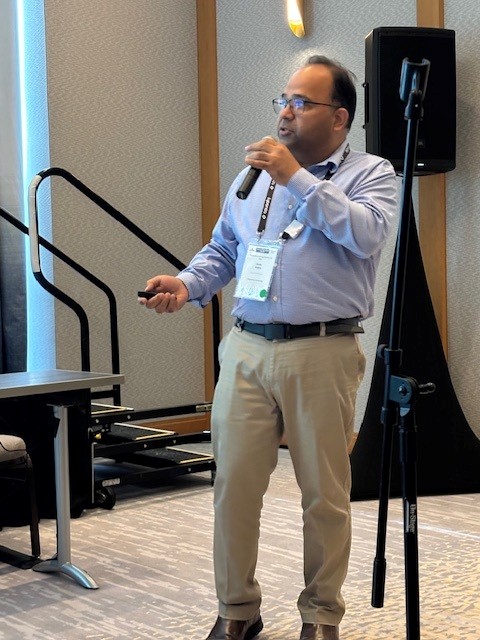
Duquesne University’s Vivek Gupta on nasal delivery
As he moved into highlighting the lab work underway in leveraging nasal delivery routes to the brain, Gupta acknowledged the potential for payload loss caused by nasal dripping. To avoid the unwanted effects of oral approaches, the approach being explored leverages gels (including nanoparticles, if desired) to a) reduce dose size and b) make the formulation “sticky.”
A key is temperature. Gupta described the conversion of a polymer-based liquid formulation into a gel within the nasal passageway. “[It] will convert into gel and will adhere to nasal mucosa. So, if you're developing a gel for a nasal product, you're looking for something that will gel at nasal temperature,” he explained. “You’re looking for bio-responsive temperatures.”
Once formed, these gels offer flexibility as payload carriers, according to Gupta. “These gels can encapsulate, as we have experienced as well,” he said. “You can load the drug into nanoparticles. You can load the drug into the gel itself. It's very versatile. It's very flexible.”
Using Nanotech For Precision Targeting
On Day 2 of the Discovery & Development US conference, I had the pleasure of introducing the opening speaker, Professor Thomas Webster, whose work at Brown University and other places focuses on the use of nano-scale biomaterials in advancing formulation and delivery science.
Centering his comments around the treatment of cancer, Webster laid the foundation of his call for innovative uses of nanotechnology with this declaration: “I firmly believe we have reached the limit of conventional medicine.”
In advocating precision targeting of cancers, Webster went on to describe ways of deploying nano-scale materials to maximize the loading of therapeutic agents. “The value of nanotechnology is increased surface area. Whenever you make a material smaller, you have so much more surface area,” Webster explained. “So, if you're going to functionalize that nanoparticle to target a cancer cell, or you're going to put a drug on the surface of that nanoparticle, you can have a much better-reacting approach to treat cancer.”
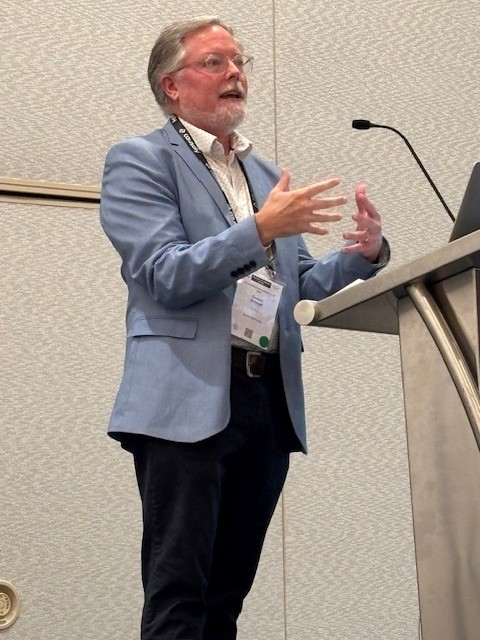
Brown University’s Thomas Webster on nanotechnology
According to Webster, a key to triggering these reactions is adding what he calls nanotextures. “One of the things that has emerged over the recent years is putting a nanotexture on a nanoparticle [to] help control what we call the protein corona,” he explained. “Whenever you inject or put nanoparticles in the body or any material in the body, proteins will absorb. If you can control that, have less inflammation, absorb more proteins that cancer cells will recognize, you can target those cancer cells. You can change that protein corona by creating select nanotextures.”
The Appeal Of AI For Discovery
As I acknowledged at the outset of this article, my editorial coverage doesn’t typically wade too far into the waters of drug discovery. Occasionally, though, I do catch up with thought leaders and entrepreneurs whose work originated in labs, including academic labs, and is moving into commercial concerns with funded aspirations for marketable products.
One such person from one such entity is Thomas von Erlach, Co-founder and CEO at Vivtex, a pipeline and platform company developing modeling tools, including high-throughput screening, for advancing oral delivery. As I had learned during a videocast with von Erlach as my featured guest, Vivtex deploys its robotic, organ-interfacing technology to conduct experiments on the GI tract in an effort to identify ways to overcome common limitations of oral delivery.
Having witnessed a couple of impassioned, seemingly skeptical, arguably dystopian views about AI for discovery expressed during the sessions, I was pondering the prevailing opinion when von Erlach stopped to chat with me at the event.
Below is the video and transcript from our catchup at the show:
Tom talking with Thomas von Erlach from Vivtex
Tom von Gunden, Drug Delivery Leader:
So, a big topic here — a lot of the vibe — is around AI. I thought I'd just ask you: How is that playing out in your world these days?
Thomas von Erlach, Vivtex:
Yes, it's becoming really a big component of what we do. I would have said maybe two, three years ago [that] I thought that it's a little bit more hype than actual use. But right now, since this year, we have invested quite a lot of effort into building out our platform to really have an AI model and ultimately predict what we do. And that really starts to shape up really nicely.
We are currently still not sure how it will progress. But right now, we are assuming that, perhaps within the next six months, the platform itself could be fully AI native. We would really not need to rely on screening anymore or maybe just for validation purposes. So, for us, that would be a pretty big deal being a screening company if we make that transition.
Great. And when it comes to AI, what's the bigger picture of the promise for the industry and especially for patients, ultimately?
I think it's maybe going beyond just predicting existing data or new data and maybe to really tell us something that we don't know and couldn't directly know if we were to do experiments.
And for us, for example, it's to synergize not just our screening data but our actual in vivo data, the totality of the literature and other aspects that could be more physical chemical in nature. Synergize this all together.
And right now, this [volume of inputs] is a little bit too much to handle for our very talented scientists. I would like to think that we have very smart scientists, and they have very big brains. But it's no match for the large language models out there.
So, I think that there is really a step up in the large language models telling us what we actually should do based on the totality of the data. Not just predicting the data but doing data interpretation and then suggesting what to do next.
Learning From Formulations Left Behind
The topic of AI for drug discovery and delivery came up again in another session I introduced, “Why Formulations Fail — Lessons Learned Across Modalities.” In commenting on early-stage research, panelist Jian Zuo, Co-Founder and CEO at Ting Therapeutics, echoed my convo with von Erlach when he identified a key control step — modeling. “I find the most important one is the modeling,” Zuo stated. “To see what kinds of formulations, what kinds of excipients, what kinds of things that would have different properties. They [CRO organizations] can search AI databases; they can do their own special models.”
Accelerating The Pace Of Failure Toward Success
On the broader topic of the session — formulation failures — the panel seemed to agree that, among the most useful pieces of advice they could offer, are these: 1) Remember that formulation is (or should be) an iterative process, and 2) that, because some formulation failures are inevitable, it may be wise to fail fast.
Panelist Adamo Sulpizi from Chiesi made the case for sometimes intentionally accelerating taking a formulation into CMC development. “You maybe don’t want the perfect formulation already in Phase 1,” he suggested. “In terms of the timelines, it’s very important. If you want a perfect formulation that is difficult to develop and takes years to go into Phase 1, that may be a cause of trouble.”
Zhu illustrated the value of early learning from formulation failures with an example of what might be revealed during scale-up. “We had one failure example of using an IV formulation,” he offered. “We had a small scale, multiple excipient, liposomal-based [formulation]. And then, when we did it at a little bit larger scale, we found out that the components cannot reach very high levels.”
What I Discovered About Drug Discovery
In reflecting on my experiences at the Discovery & Development US conference, I believe I have answered, at least for myself, the question I posed in the title of this article: Does discovery anticipate delivery? Indeed, it does — always implicitly, often overtly. About the cross-functional, cross-stage nature of drug discovery, development, and delivery, it’s a matter of everyone, to varying degrees, thinking about all of the above, all at once, all the time.
There exists a mantra, of sorts, quietly humming throughout the commentaries and conversations I reported above, just as it has been in various articles and avenues in our coverage on Drug Delivery Leader: Whether the question reflects an early-stage decision point, as in, “Can this molecule work therapeutically?” or one at a later stage, as in, “Can this therapy be delivered in this way?” that mantra goes something like this: Find out as early as possible. And do that by getting everyone from all disciplines at the table early and often.