
Drug–Device Combination Products: Bridging Formulation, Device, And Manufacturing Decisions
By Hardikkumar Jayantibhai Lathiya, Senior Manufacturing Engineer, Medtronic

Many drug–device combination products can be developed to achieve the therapeutic goal and still face significant challenges in the manufacturing phase. Laboratory performance might be different from what occurs during coating, drying, sterilization, assembly, and/or high-throughput production. Similarly, a mechanical requirement may not be met by a device architecture that would load, distribute, and release the required drug and/or maintain its stability.
For combination products, teams must assess the drug, the device, the manufacturing process, and the environment in which the product is used as an integrated system. According to the FDA, mixing drug and device ingredients can pose scientific and technical challenges that can be different when each part is considered separately.1
One way of doing that is to convert the therapeutic target into measurable product requirements and then transfer these product requirements from formulation development to device design, process development, manufacturing control, and life cycle management. This article uses drug-coated medical devices and precision coating as a practical example and provides a framework to make those connections earlier.
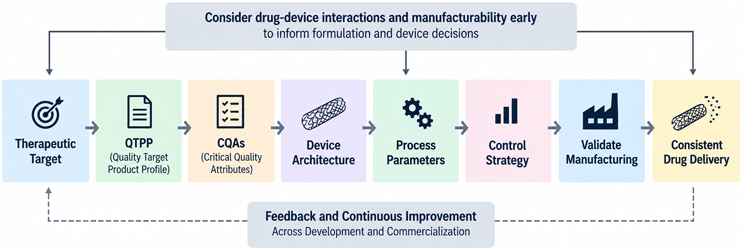
Figure 1: Integrated development chain for drug–device combination products
Translating Formulation Properties Into Manufacturing Requirements
Potency, dissolution, or stability are not the only issues that should be considered in formulation development. Viscosity, surface tension, density, solids concentration, solvent composition, volatility, polymer concentration, and drying behavior can affect deposition and film formation for coating-based drug delivery systems.
The viscosity, liquid flow rate, atomization parameters, substrate temperature, and drying conditions are all factors that may affect the formation of droplets, deposition efficiency, coating morphology, and uniformity in ultrasonic spray coating. On small and complex medical device geometries, for example, it may not be possible to simply move a formulation from one equipment configuration to another.
The need to consider focused ultrasonic architectures, process parameters, critical process parameter (CPP)/critical quality attribute (CQA) relationships, design of experiments (DoE), quality by design (QbD), statistical process control (SPC), coating defects, and scale-up all together has been reviewed in a recent article for ultrasonic spray coating for drug-loaded medical devices.2
The development question thus needs to be shifted from “Does this formulation work?” to “What formulation and process window can be used to convert this formulation repeatedly into the desired attribute of the product?” Teams can respond to that question by describing formulation property conditions during manufacturing-relevant conditions and relating these properties to process parameters and CQAs.
Treat The Drug-Device Interface As A System
A combination product is not a drug or device, it's both. The interface between the two can be a deciding factor on the finished product. For a drug-coated implant, there is a need to assess interactions between the drug, polymer or excipients, coating, substrate, device geometry, manufacturing process, sterilization conditions, and clinical environment.
A coating can have an average thickness requirement and have variations of thickness in local areas such as edges, curved surfaces, recessed areas, or changes in geometry. It can also have acceptable drug content but poor handling and deployment mechanical adhesion. Examples provided by the FDA include polymer coating characteristics that may impact deployment, drug release, biocompatibility, and stability with a drug-eluting stent.1
When describing what is present, the description should also include where it is present and how it is moving. The coating’s thickness distribution, drug distribution, surface morphology, adhesion, defect frequency, release behavior, and mechanical integrity are some of the useful evaluations that can be performed. Teams also should consider the coating following sterilization, packaging, transportation, and simulated use to ensure that the coating is acceptable after the process.
, Fixtures, rotation, orientation of the nozzle, trajectory of the spray, and drying conditions can become factors affecting the product quality – and not just for complex 3D surfaces. Considering these variables with the drug-device system will enable teams to detect interactions early in the process, before they become a late-stage design issue.
Convert CQAs Into Critical Process Parameters
When the CQAs are determined, the next step is to determine the manufacturing variables that control them. The following process parameters may be considered for ultrasonic spray coating: ultrasonic frequency, atomization power or amplitude, liquid flow rate, shroud flow, nozzle to substrate distance, traverse speed, substrate rotation, coating passes, and drying conditions.
When interactions are possible, teams should not attempt to optimize these parameters independently. Also, wet-film formation and drying requirements can vary with liquid flow, and droplet characteristics and deposition efficiency may vary with atomization energy.
DoE can make a systematic assessment of the main effects, interactions, nonlinearity, sensitive parameters, and robust operating regions. The goal should not be an “optimal” setting. The range of operating windows should be strong enough to withstand the normal variation of materials, equipment, environment, and production process. An important process parameter can then be related to the CQA that it affects, and rational operating limits and monitoring can be established based on risk-based analysis.
Design For Manufacturability Before Design Freeze
Faster teams find manufacturing issues after the product architecture is fixed, when they are more costly to address. Thus, a design for manufacturability review should be conducted during the evolving nature of formulation and device design.
Prior to design freeze, teams should consider the following questions related to the formulation: Can it be deposited consistently? Can complex geometry be coated uniformly? Can it be automated? Can any defects be detected? Can it meet the throughput requirements? Can it be validated? Manual masking, positioning, coating, inspection, and demasking operations can introduce operator variations, add to the cycle time, and increase the risk of product damage. Maskless or automated processes can simplify the process and increase repeatability when technologically feasible.
The objective is not automation for the sake of automation. The aim is to develop a process that consistently yields important product characteristics and can be reliably measured. The review should include the entire process: component preparation, fixturing, coating (or drug loading), drying, inspection, handling, and packaging. Another key element of FDA guidance on combination-product current good manufacturing practice (cGMP) requirements is the assessment of the impact of manufacture on component interactions.3

Move From End-of-Line Inspection To Process Understanding
Not all the attributes of many combination products are amenable to end product testing. For instance, a final drug loading measurement can only give an overall value for total loading and may offer little information on spatial distribution or process conditions of the loading.
QbD, process analytical technology (PAT), SPC, and measurement system validation can be used to transition the manufacturing paradigm from "make, inspect, reject" to "understand, control, monitor, verify." The process should build a relationship between the material attributes, equipment, process, and CQAs.
Measurement system analysis and gage R&R can help decide if there is variation in the product or in the measurement system. In-process monitoring may offer the detection of process drift earlier and may minimize reliance on end of line monitoring. The FDA's process validation guidance focuses on understanding sources of variation, detecting variation, understanding the impact of variation on product attributes, and controlling variation by risk.4
Make Scale-Up A Scientific Exercise
Scale-up is not just scaling up the process. Process performance may vary due to equipment, throughput, environmental exposure, changes in material lots, automation, process duration, and drying behavior. The critical issue is: What should stay the same in order to have the same performance of the product?
Scale-up variables that can be useful for coating processes are mass deposited per unit area, coating thickness distribution, surface coverage, drying conditions, energy delivered to the formulation, substrate exposure time, drug-to-polymer ratio, and residence time. These relationships can be defined, and technology transfer can be more scientific and less dependent on trial-and-error adjustments.
Cycle time, yield, defect rates, equipment utilization, and material consumption should also be considered within the team. Industrial processes that produce an undue amount of scrap or demand a lot of manual reworks may not be economically viable. In the FDA’s combination product guidance, manufacturing and scaling up are listed as critical development considerations, and evaluating the interactions of constituents is recommended as part of the consideration of the effect of manufacturing methods.1
Use Data Without Losing Process Understanding
Today's manufacturing systems are responsible for producing data sets that include the equipment parameters, environmental parameters, information about material lots, inspection data, laboratory data, yield data, and defect data. These data sets can be combined to enable teams to leverage multivariate monitoring, regression models, machine learning, Bayesian optimization, surrogate modeling, and approaches like digital twin.
These tools should be used in addition to, not in lieu of, process understanding. Prior to applying advanced analytics, teams must first develop a set of reliable measurements of CQA, a set of representative manufacturing data, and a scientific understanding of the relationship between process variables and product performance. Both DoE and data-driven approaches are useful for designed experiments and can be useful for identifying patterns and prioritizing experiments in areas of interest.
There is a simple test to follow when using an AI model: Is the data input representative? Can trust be placed on the measurement system? Can the output of the model be linked to a product or process decision? If the answer to any of these is no, enhancing understanding of the process should be done first.
Connect Development, Validation, And Life Cycle Management
Design verification and manufacturing validation should convey the same technical message. Design verification is asking the question, does the product meet the requirements? Manufacturing validation is asking, can the manufacturing process produce the product? If the product is a combination product, the links in the chain can be design input, design output, manufacturing process, CQA, performance requirement.
The FDA's combination product cGMP guidance clarifies that application of quality target product profile (QTPP) and CQA principles can be used in conjunction with the device design inputs and outputs, thereby providing a link between the pharmaceutical development and device design controls.5
This link is also significant once the product is sold. This can vary with new raw material suppliers, equipment changes, process improvements, transfers, automation improvements, and capacity expansion. When teams have a solid grasp of the parameters that have the greatest impact on product performance, they can better assess changes to the product's life cycle.
Additionally, when assessing drug delivery device changes, the FDA's draft guidance on essential drug delivery outputs is particularly focused on the relevant device design attributes and manufacturing processes.5
Five Questions To Ask Before Design Freeze
- Does the formulation have commercial scale manufacturing potential (not just in the laboratory)?
- Which properties of the formulation directly impact the device, coating, or drug delivery performance?
- What are the most important and reproducible process parameters for the critical quality attributes?
- Is there meaningful process variation that the measurement system can detect before the product is subjected to final inspection?
- Are formulation-device-process connections going to be strong enough throughout scale-up, technology transfer, and throughout the life cycle?
Conclusion: Connect The Decisions Earlier
Teams need to venture beyond constituent part performance to help bridge the gap between drug formulation and manufacturable devices. For a combination product to be successful, it must meet the therapeutic goal, retain both drug and device functionality, be manufacturable with acceptable variation, and have a process that is acceptable for commercial scale control and validation.
The most beneficial development chain is very simple: therapeutic target to QTPP to CQAs to device architecture to process parameters to control strategy to validate manufacturing to consistent drug delivery. Teams can make this chain more effective by considering drug-device interactions and manufacturability prior to formulation and device decisions.
Where the manufacturing process can impact the distribution and release of the drug (such as drug-coated implants), this integrated approach can potentially help mitigate risks earlier in the process and minimize the need for late-stage redesign. Different teams involved with formulation, device design, manufacturing, quality, and data interpret all facets of the system, and a unified technical approach can lead to better commercial results.
References:
- U.S. Food and Drug Administration (FDA). Early Development Considerations for Innovative Combination Products. Guidance for Industry and FDA Staff. 2006.
- Lathiya HJ, Kolapkar PH. Ultrasonic Spray Coating for Drug Loaded Medical Devices: A Review of Focused Beam Architectures, Process Control, and Future Directions. International Journal of Drug Delivery Technology. 2026;16(6s):405-429. DOI: 10.25258/ijddt.16.6s.43.
- U.S. Food and Drug Administration (FDA). Current Good Manufacturing Practice Requirements for Combination Products. Guidance for Industry and FDA Staff. January 2017.
- U.S. Food and Drug Administration (FDA). Process Validation: General Principles and Practices. Guidance for Industry. January 2011.
- U.S. Food and Drug Administration (FDA). Essential Drug Delivery Outputs for Devices Intended to Deliver Drugs and Biological Products. Draft Guidance for Industry and FDA Staff. June 2024.
About The Author:
 Hardikkumar Jayantibhai Lathiya is a senior manufacturing engineer at Medtronic specializing in advanced manufacturing, process development, and industrialization of Class III implantable medical devices and drug-device combination products. With more than five years of engineering experience across the U.S. and Ireland, his work focuses on translating medical drug-device concepts into robust, scalable, and manufacturable processes. Lathiya's technical expertise includes ultrasonic spray coating, manufacturing process optimization, design of experiments (DoE), gage R&R of weigh balances, process validation, and technology transfer. His work has contributed to approximately 9% manufacturing yield improvement, increased production capacity, and reduction in process cycle time. He is also an inventor on a U.S. patent application related to drug-coating process technology. He has authored publications in Scopus-indexed venues, including research on AI-driven closed-loop process control for drug-eluting stent manufacturing and ultrasonic spray coating for drug-loaded medical devices. He is an ASQ Certified Six Sigma Green Belt. He can be reached via email at hardik.lathiya@medtronic.com.