
Engineering Medical Devices To Improve Oral Delivery Of Biopharmaceuticals
By Partha Anbil, Life Sciences Industry Advisor, MIT Sloan Career Development Office
For two decades, oral delivery of biologics was an aspiration with no commercial proof point. That changed in nine months. On December 22, 2025, the FDA approved oral semaglutide 25 mg — a Wegovy tablet — as the first oral GLP-1 for chronic weight management.1,2 Novo Nordisk launched it on January 5, 2026, and booked roughly $355 million in its first quarter on 1.3 million prescriptions, then raised full-year guidance.3 On April 1, 2026, Eli Lilly's orforglipron (Foundayo) followed, a once-daily non-peptide GLP-1 taken without food or water restrictions.4 By mid-2026, the oral obesity franchise had passed 3 million prescriptions.5
One data point deserves more attention than the revenue: Novo reports that roughly 80% of pill users are new to GLP-1 therapy rather than switchers from the injection.5 The tablet did not cannibalize the pen — it expanded the treated population. That is the strongest evidence yet that route of administration, not efficacy alone, gates uptake in chronic disease, and it resets the commercial case for every ingestible delivery platform now in development.
The commercial logic behind that expansion is adherence. Real-world analyses through 2025 and 2026 consistently show that a large share of patients — by several claims-based studies, close to half — discontinue an injectable GLP-1 within 12 months, with tolerability, cost, and administration burden all contributing.6,7 Any technology that removes the needle without giving up exposure is therefore competing not only for new starts but for the persistence curve, which is where the lifetime value of a chronic therapy actually sits.
It also sets a trap. The two approvals solved the problem for exactly two molecules, by two routes that do not generalize.
What The Pills Proved — And What They Did Not
Orforglipron is a small molecule. It is orally bioavailable because it was designed to be: no permeation enhancer, no device, no fasting window.4 That route is closed to peptides much above a few hundred daltons and closed entirely to monoclonal antibodies, enzymes, mRNA, and siRNA — the molecules that dominate current pipelines.
Oral semaglutide takes the other route: co-formulation with SNAC, a permeation enhancer that transiently raises local absorption in the stomach. Absolute bioavailability sits at 0.4%–1%.8 The tablet reaches clinically meaningful weight loss — 16.6% among adherent patients in OASIS-41 — by brute force, delivering roughly 25 to 30 times the injected dose to compensate, under a fasting window with no more than 120 mL of water and a 30-minute wait before food. That arithmetic is a manufacturing tax: every milligram absorbed requires roughly 100 milligrams to be synthesized, purified, and formulated. It is tolerable for one peptide with an enormous market and heavy API investment behind it. It is not a template.
The 1% Ceiling
A 2026 review in Frontiers in Drug Delivery frames the field usefully as a split between barrier-limited formulation and active convective transport.9 Chemical strategies — permeation enhancers, nanoparticles, protease inhibitors — work within the constraints of tight junctions, mucus, and luminal enzymes and hold absolute oral bioavailability below 1% for essentially all biologics; SNAC-class formulations run 0.1%–2%. Devices break that ceiling by changing the physics. Rather than persuading a large molecule across the epithelium, they place it beneath it.
Human data now exist. Rani Therapeutics' RT-111, an oral ustekinumab biosimilar in the RaniPill capsule, achieved 84% bioavailability relative to subcutaneous injection in a 55-subject Phase 1, with no serious adverse events and capsule remnants passed by all participants.10 In July 2026 the company reported Phase 1a results for RT-114, a GLP-1/GLP-2 dual agonist, showing systemic exposure above 150% of a matched 12 mg subcutaneous dose, a comparable elimination half-life (5.6 versus 5.3 days), and no adverse events attributed to the capsule itself.11 For antibody- and peptide-scale molecules, mechanical delivery is currently the only demonstrated path to injection-equivalent exposure (Table 1).
One under-discussed finding from that Phase 1 deserves emphasis for anyone modeling a device program: anti-drug antibody rates for the orally delivered antibody were comparable to the subcutaneous comparator.10 Intramural delivery into the small bowel wall did not, on this early evidence, provoke the immunogenicity penalty many reviewers assumed it would — a risk that has quietly discounted the valuation of every needle-bearing ingestible platform.
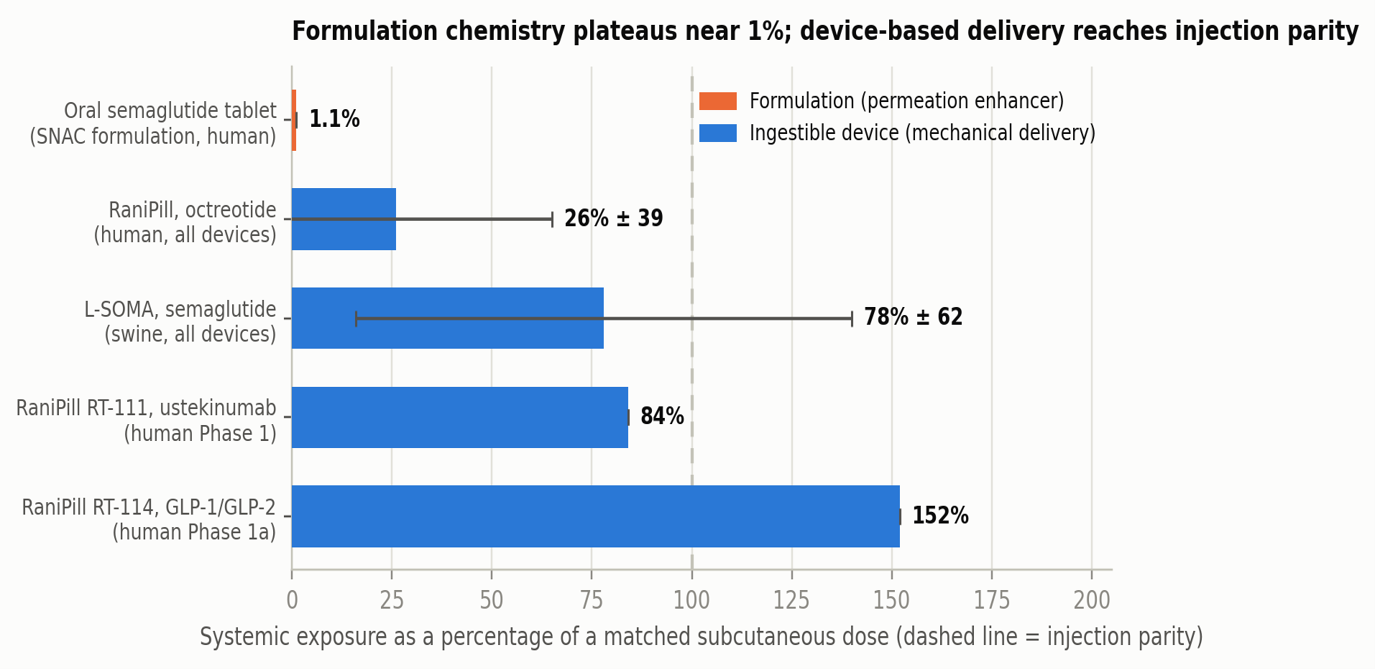
Figure 1: Exposure achieved by the oral route, expressed against a matched subcutaneous dose. Formulation chemistry and device-based delivery are separated by two orders of magnitude. Error bars are standard deviations across all administered devices, including failed actuations. Data sources: refs. 8, 9, 10, 11, 12, 13.
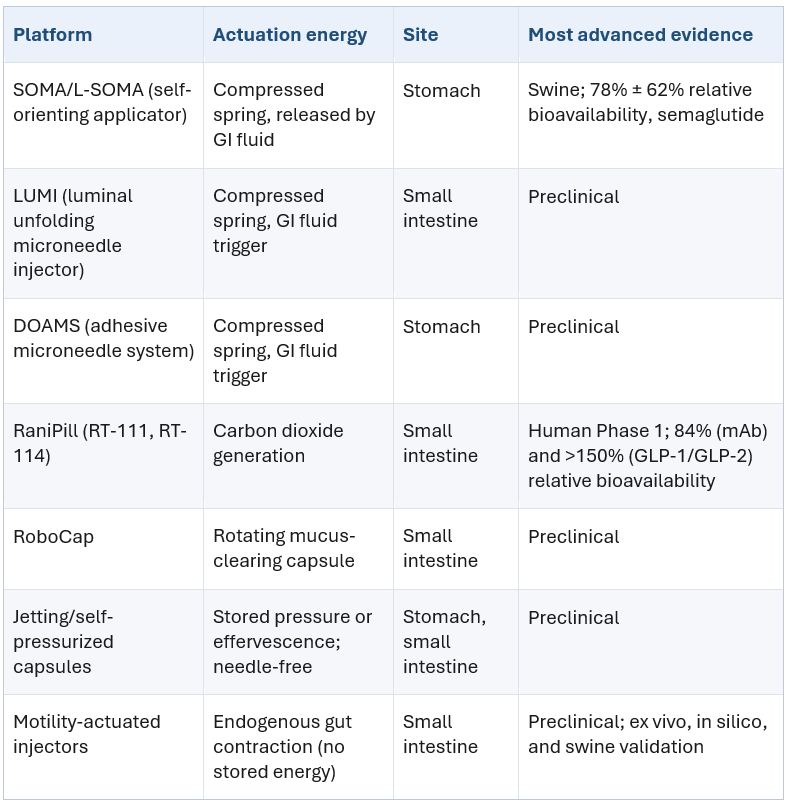
Table 1: Ingestible delivery platforms and their most advanced evidence. Data sources: refs. 9–19.
The Unsolved Variable Is Reliability, Not Absorption
Bioavailability headlines obscure the failure mode that actually blocks approval. In the RaniPill clinical study of octreotide, 32 of 36 devices released their dose, but only 13 released into tissue — a 41% hit rate — with the remainder discharged into the lumen, where absorption was effectively zero. Mean relative bioavailability across all devices was 26% ± 39%.12 In swine, the liquid-injecting SOMA device placed three of four doses into tissue for 78% ± 62%.13 In both cases, the mean approaches injection parity, and the standard deviation exceeds the mean.
The root cause is architectural rather than biological. First-generation ingestible injectors store energy — a compressed spring, a carbon dioxide generator — and spend it in a single irreversible actuation triggered by a proxy for position: moisture, pH, or elapsed time. One misfire forfeits the entire dose. Orientation compounds the problem; a single fixed orifice achieves correct mucosal apposition in roughly one-quarter to one-third of delivery events.9 For a weekly biologic, a 40% hit rate is not a dosing regimen, and the comparator regulators will reach for a syringe that works every time.
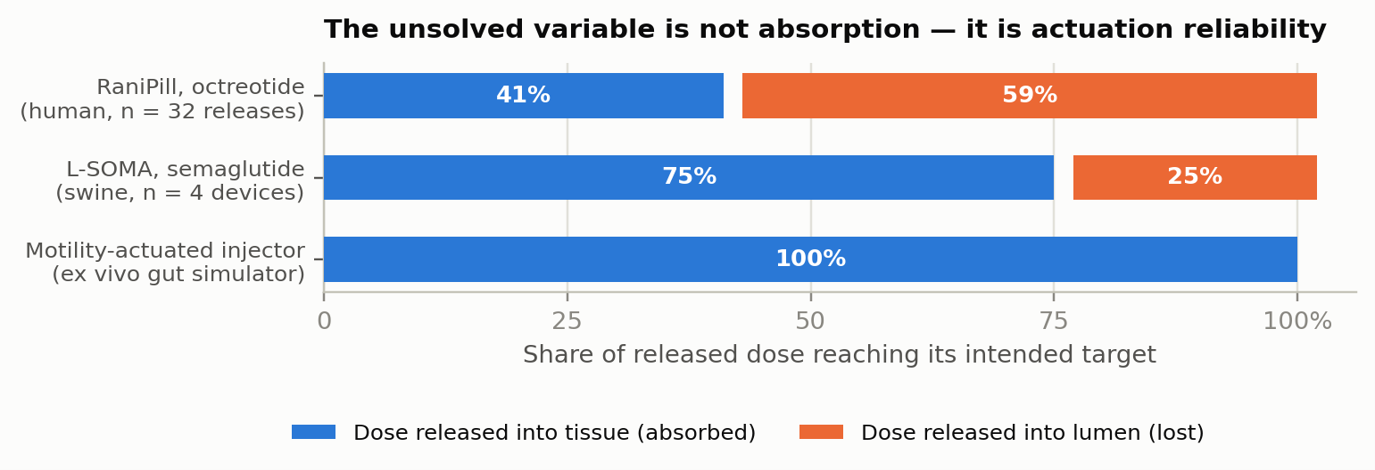
Figure 2: Where the released dose actually goes. Dose discharged into the lumen is lost to enzymatic degradation and the epithelial barrier. The first two rows are published clinical and swine data (refs. 12, 13); the third is device characterization in an electromechanical gut simulator, so the comparison is directional rather than a like-for-like clinical benchmark.
Motility As A Power Source, Not An Obstacle
Second-generation designs invert the founding assumption. Gut motility has been treated as noise — the thing that dislodges devices, randomizes transit, and defeats timed release. It is also a continuous free supply of mechanical work: contractions of roughly 0.7 N, about 4.8 seconds in duration, at roughly 12 per minute in the human small intestine.20,21 A device tuned to that force envelope needs no stored energy at all and gets a fresh actuation attempt every few seconds (Table 2).
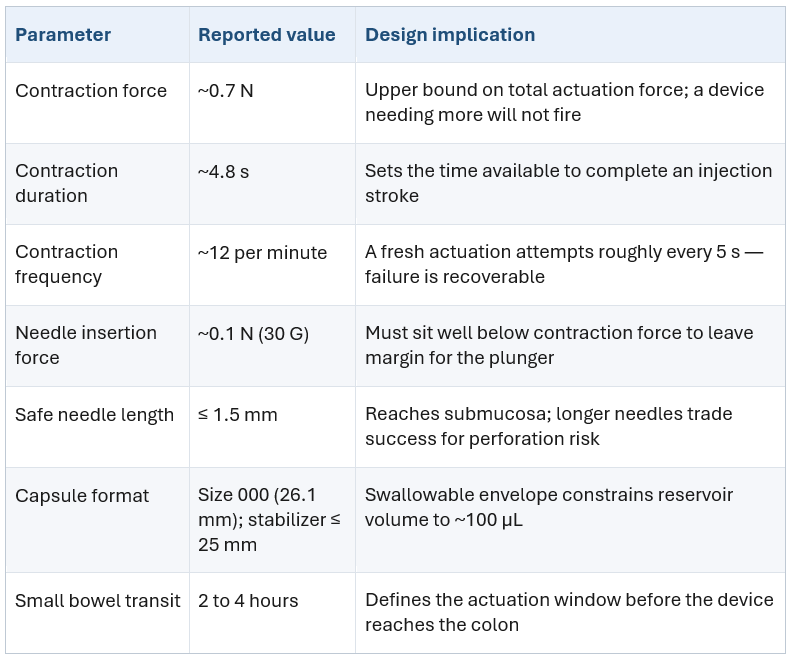
Table 2: The mechanical design envelope of the human small intestine. Data sources: refs. 20, 21, and device characterization data discussed in the text.
Academic work has converged on this quickly. Cephalopod-inspired jetting capsules that dispense needle-free,18 peristalsis-actuated microneedle robots,19 self-pressurized convective capsules,9 and compression-triggered injectors modeled on the stonefish envenomation apparatus all draw their actuation energy from the gut rather than from a spring. In the last of these, a short needle anchors in the mucosa and the plunger advances only when the contraction force exceeds the sum of needle insertion force (~0.1 N) and plunger friction (~0.45 N) — a force balance that makes injection conditional on correct tissue engagement.
Two design consequences travel well to any program. First, dose delivery becomes fractional and resumable: a partial actuation is completed on the next contraction instead of being forfeited, which converts a single high-stakes event into a series of low-consequence ones. Second, geometry does the targeting. Needle length is the safety–efficacy dial, and the stabilizer body that holds the device transverse to the bowel wall raises the probability of an injectable orientation from about a third, for a freely tumbling injector, to between 61% and 100% depending on luminal conditions.
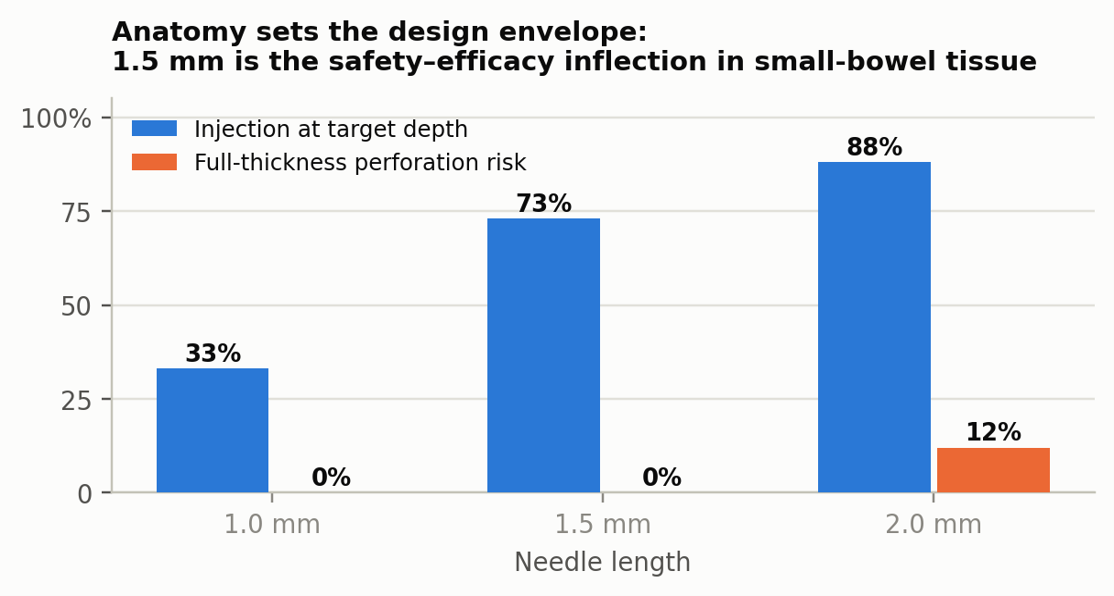
Figure 3: Needle length sets the trade-off between reaching the submucosa and perforating the bowel wall in ex vivo small intestinal tissue. Beyond 1.5 mm, incremental success is bought with perforation risk. Underlying tissue mechanics measurements: refs. 20, 21.
This also reframes the validation stack. Benchtop electromechanical gut simulators that reproduce contraction force, duration, and frequency around real explanted tissue — paired with in silico orientation modeling — are becoming the qualifying evidence for actuation reliability, with large animal work reserved for confirmation. That is a meaningfully cheaper development path than iterating in swine.

Simplicity As A Manufacturing Strategy
Multi-part actuation mechanisms demand precision assembly, tight tolerance stacks, and stringent quality control at unit volumes no device company has ever run. Architectures built from modified syringe components inherit an existing heavily capitalized supply chain instead of creating a new one — an argument that carries more weight with a commercial partner than any preclinical bioavailability figure.
The surrounding ecosystem is industrializing in parallel. Ashland launched permexa sodium caprate in August 2026, a pharmaceutical-grade intestinal permeation enhancer engineered for powder flow and compressibility, signaling that oral-peptide excipients are becoming commodity inputs rather than bespoke chemistry.22 Peptide CDMO capacity expansion in North America hit multiyear highs in 2026.23 And Novo notes that the oral formulation removes cold chain for the finished product2 — a distribution and access lever that matters far beyond the United States.
Capital Has Arrived, And So Has The Cautionary Tale
Money followed the approvals. In February 2026 Novo Nordisk committed up to $2.1 billion in milestones plus royalties to Vivtex, the MIT-founded company whose gut-on-a-chip platform screens formulations for intestinal permeability.24 Rani has partnered with ProGen and Celltrion on its lead assets.10,11 Lilly continues to pour billions into peptide API capacity.
Set against that, Biora Therapeutics — developer of the NaviCap targeted-delivery capsule — filed for Chapter 11 and converted to Chapter 7 liquidation, despite credible clinical data.25 Platform companies burn device development capital on pharmaceutical timelines without pharmaceutical revenue. The structural lesson for delivery programs is partnership-first: a capsule is worth what the molecule inside it is worth, and the molecule's owner is the party who can fund the pivotal work.
The Evidence Gaps That Will Decide Filings
There is still no standardized regulatory paradigm for ingestible delivery devices; they are combination products assessed case by case. FDA's June 2024 draft guidance on Essential Drug Delivery Outputs (docket FDA-2024-D-2560)26 is the closest available structure, asking sponsors to identify the device outputs essential to delivery performance — which, for an ingestible injector, means delivered dose, injection depth, and actuation success rate, characterized as specifications rather than as study observations.
Five gaps are worth funding now, before a commercial partner asks about them (Table 3). Two deserve particular emphasis. The first is characterization of delivered dose in populations whose motility is not normal — gastroparesis, inflammatory bowel disease, post-bariatric anatomy, and, pointedly, concomitant GLP-1 therapy, which slows gastric emptying in precisely the patients an oral device is most likely to serve. The second is chronic gastrointestinal safety: a weekly device-delivered biologic implies hundreds of mucosal penetrations over a treatment course, and no platform has published repeat dose toxicology at that scale.
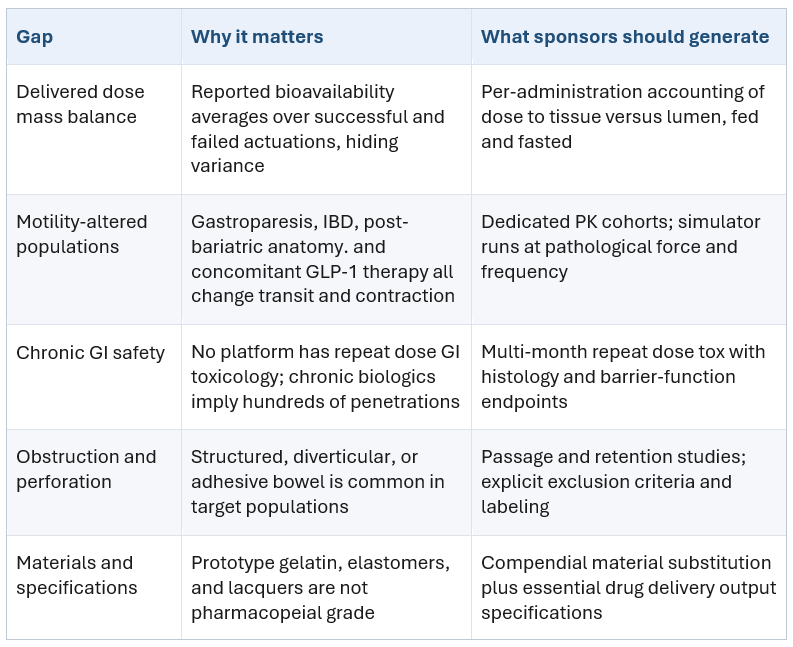
Table 3: Evidence gaps for ingestible delivery devices. Regulatory framing follows FDA draft guidance on essential drug delivery outputs (ref. 26) and the translational gaps cataloged in ref. 9.
What To Watch Through 2027
- Repeat dosing. The RT-114 Phase 1b repeat dose study in obesity, starting in 2026 with data expected in 2027,11 will be the first multi-week efficacy readout for a device-delivered GLP-1 — the point at which reliability is measured across dozens of administrations per patient rather than one.
- Molecule selection. The commercially interesting target is not a fourth oral GLP-1 but a molecule with no viable injectable-to-oral chemistry: a monoclonal antibody in inflammatory bowel disease or dermatology, where the device is the only route and the comparator is a self-injection patients already dislike.
- Platform maturity. Watch whether motility-harnessing architectures — no stored energy, multiple actuations, syringe-derived parts — move from benchtop simulators into IND-enabling toxicology. That transition is the field's next credibility test.
- Price anchoring. Oral GLP-1s now sell at $149 to $299 per month cash.3,4 That sets the price umbrella under which any oral biologic must justify a device premium, and it is falling, not rising.
The Bottom Line
The approvals of the past nine months validated demand and, in the same stroke, exposed the ceiling. Chemistry moved one peptide across the epithelium at roughly 1% efficiency; a small molecule went around the problem entirely. Neither route carries an antibody. Devices do — at 84% to more than 150% of subcutaneous exposure in human studies — and their remaining defect is reliability, an engineering variable with known inputs: contraction force, needle geometry, device orientation, and the number of actuation attempts allowed. The programs most likely to convert today's enthusiasm into a filing are the ones that treat gut motility as a specification rather than an obstacle and that design for many low-consequence actuations instead of one high-stakes shot.
References
- Novo Nordisk. FDA approves Novo Nordisk's Wegovy pill, the first and only oral GLP-1 for weight loss in adults. December 22, 2025. https://www.prnewswire.com/news-releases/fda-approves-novo-nordisks-wegovy-pill-the-first-and-only-oral-glp-1-for-weight-loss-in-adults-302648344.html
- Fierce Pharma. Novo Nordisk wins FDA approval for Wegovy in a pill, introducing first oral GLP-1 option for obesity. December 2025. https://www.fiercepharma.com/pharma/novo-nordisk-wins-fda-approval-wegovy-pill-introducing-first-oral-glp-1-option-obesity
- Fierce Pharma. Novo CEO cites pricing "sweet spot" as Wegovy pill debuts with $355M quarter. 2026. https://www.fiercepharma.com/pharma/novo-ceo-cites-wegovy-pill-pricing-sweet-spot-oral-obesity-launch-garners-355m-its-1st
- Eli Lilly and Company. FDA approves Lilly's Foundayo (orforglipron), the only GLP-1 pill for weight loss that can be taken any time of day without food or water restrictions. April 1, 2026. https://investor.lilly.com/news-releases/news-release-details/fda-approves-lillys-foundayotm-orforglipron-only-glp-1-pill
- Fierce Pharma. ADA: Novo's Wegovy pill reaches new GLP-1 patients with 3M prescription milestone. 2026. https://www.fiercepharma.com/pharma/ada-novos-wegovy-pill-reaches-new-glp-1-patients-impressive-3m-prescription-milestone
- Blue Health Intelligence. Real-world trends in GLP-1 treatment persistence and discontinuation (issue brief). https://www.bcbs.com/media/pdf/BHI_Issue_Brief_GLP1_Trends.pdf
- Trends in 1-year persistence and adherence among initiators of high-potency, weight loss-indicated GLP-1 receptor agonists. 2025. https://pmc.ncbi.nlm.nih.gov/articles/PMC12948759/
- Overgaard RV, et al. Clinical pharmacokinetics of oral semaglutide: analyses of data from clinical pharmacology trials. Clin Pharmacokinet. 2021;60(10):1335–1348. https://doi.org/10.1007/s40262-021-01025-x
- Niazi SK. Oral delivery of biologics: from barrier-limited formulation to active convective transport. Frontiers in Drug Delivery, 4 May 2026. doi:10.3389/fddev.2026.1783113 https://www.frontiersin.org/journals/drug-delivery/articles/10.3389/fddev.2026.1783113/full
- Rani Therapeutics. Positive topline results from Phase 1 study of an oral anti-interleukin 12/23 antibody (RT-111). February 2024. https://ir.ranitherapeutics.com/news-releases/news-release-details/rani-therapeutics-announces-positive-topline-results-phase-1-0/
- Rani Therapeutics. Positive initial Phase 1a data for RT-114 for the treatment of obesity, with oral bioavailability exceeding matched subcutaneous dosing. 15 July 2026. https://www.globenewswire.com/news-release/2026/07/15/3327637/0/en/Rani-Therapeutics-Announces-Positive-Initial-Phase-1a-Data-for-RT-114-for-the-Treatment-of-Obesity-with-Oral-Bioavailability-Exceeding-Matched-Subcutaneous-Dosing.html
- Dhalla AK, et al. A robotic pill for oral delivery of biotherapeutics: safety, tolerability, and performance in healthy subjects. Drug Deliv Transl Res. 2022;12(1):294–305. https://doi.org/10.1007/s13346-021-00938-1
- Abramson A, et al. Oral delivery of systemic monoclonal antibodies, peptides and small molecules using gastric auto-injectors. Nat Biotechnol. 2022;40(1):103–109. https://doi.org/10.1038/s41587-021-01024-0
- Abramson A, et al. An ingestible self-orienting system for oral delivery of macromolecules. Science. 2019;363(6427):611–615. https://doi.org/10.1126/science.aau2277
- Abramson A, et al. A luminal unfolding microneedle injector for oral delivery of macromolecules. Nat Med. 2019;25(10):1512–1518. https://doi.org/10.1038/s41591-019-0598-9
- Chen W, et al. Dynamic omnidirectional adhesive microneedle system for oral macromolecular drug delivery. Sci Adv. 2022;8(1):eabk1792. https://doi.org/10.1126/sciadv.abk1792
- Srinivasan SS, et al. RoboCap: robotic mucus-clearing capsule for enhanced drug delivery in the gastrointestinal tract. Sci Robot. 2022;7(70):eabp9066. https://doi.org/10.1126/scirobotics.abp9066
- Cephalopod-inspired jetting devices for gastrointestinal drug delivery. Nature. 2024. https://doi.org/10.1038/s41586-024-08202-5
- Pain-free oral delivery of biologic drugs using intestinal peristalsis-actuated microneedle robots. Sci Adv. 2024;10:eadj7067. https://doi.org/10.1126/sciadv.adj7067
- Kamba M, Seta Y, Kusai A, Nishimura K. Comparison of the mechanical destructive force in the small intestine of dog and human. Int J Pharm. 2002;237(1–2):139–149. https://doi.org/10.1016/S0378-5173(02)00046-4
- Avvari RK. Biomechanics of the small intestinal contractions. In: Digestive System — Recent Advances. IntechOpen, 2019. https://doi.org/10.5772/intechopen.86539
- Ashland. Ashland advances high-growth oral biologics delivery applications with launch of permexa sodium caprate. August 24, 2026. https://www.globenewswire.com/news-release/2026/08/24/3349618/0/en/ashland-advances-high-growth-oral-biologics-delivery-applications-with-launch-of-permexa-sodium-caprate.html
- PeptideStaff. CDMO capacity expansion in North America: peptide manufacturing investment hits five-year high in 2026. https://peptidestaff.com/news/cdmo-capacity-expansion-north-america-peptide-2026/
- BioPharma Dive. With Vivtex deal, Novo gains a chance at better oral obesity drugs. February 25, 2026. https://www.biopharmadive.com/news/vivtex-novo-nordisk-oral-obesity-drugs-biologics/812754/
- Kroll Restructuring Administration. Biora Therapeutics, Inc. — Chapter 11 case docket and conversion to Chapter 7. https://cases.ra.kroll.com/biora/
- U.S. Food and Drug Administration. Essential Drug Delivery Outputs for Devices Intended to Deliver Drugs and Biological Products. Draft guidance, June 2024 (docket FDA-2024-D-2560). https://www.fda.gov/regulatory-information/search-fda-guidance-documents/essential-drug-delivery-outputs-devices-intended-deliver-drugs-and-biological-products
Disclaimer: The views expressed in the article are those of the author and not of the organizations they represent.
About The Author:
 Partha Anbil is at the intersection of the life sciences industry and management consulting, with over 30 years of experience in life sciences. He is also a life sciences industry advisor at MIT, his alma mater. He held senior leadership roles at WNS, IBM, Booz & Company, Symphony, IQVIA, KPMG Consulting, and PWC. Anbil has consulted with and counseled health and life sciences clients on structuring solutions to address strategic, operational, and organizational challenges. He is a diplomat-in-residence and fellow at MIT CSAIL and is a healthcare expert member of the World Economic Forum (WEF). He was a member of the IBM Industry Academy, a highly selective group of professionals inducted by invitation only and considered IBM's highest honor.