
Part 4 cGMP Summaries For Combination Products: Uncovering FDA Expectations
By Doug Mead, CP Pathways LLC
If you’ve been following my series of articles on Drug Delivery Leader, you will know that I have been touting the benefits and illustrating the results of using Gen AI search tools to uncover regulatory precedents. Well, I am back reporting on additional insights gained from conducting precedent research into FDA policy. This time, I focused on a major source of regulatory uncertainty in delivery device BLA and NDA submission content. That is, what type of summary should be included in a BLA or NDA to demonstrate compliance with 21 CFR Part 4, Subpart A cGMPs for combination products? The answer is not in any specific guidance but can result in submission Information Requests if there are deficiencies in the content, or in some cases, trigger FDA interest in a pre-approval inspection.
Specifically, I wanted to know: What detail does FDA expect in the summary? How is it reviewed and by whom? And what summary deficiencies has the FDA disclosed in recent BLA and NDA submission reviews that can then be addressed in new BLA or NDA Part 4 summaries to reduce the risk of a compliance-related Information Request?
Again, the primary purpose of this article is to show how GenAI search tools and precedent research can be used, and should be used, by regulatory, quality, and delivery device functions to minimize regulatory risks. As I have been reiterating throughout this series of articles, these precedent searches need to become an essential skill set to be used judiciously when questions arise about FDA expectations.
Again, these searches will often not provide black-and-white answers to the framed questions. As with any AI search tool, I suggest always reviewing the source documents and the FDA comments posted and deciding how to address what was said in your quality documents and regulatory submissions.
One additional caveat: The article at hand is not intended as a treatise on how to implement a risk-based cGMP system for a combination product with a drug Primary Mode of Action (PMOA). Rather, it is intended to offer search results that may help guide the expected BLA or NDA submission content for the combination product an organization may be developing.
So, let’s dive back in.
The Foundation: What The Part 4 Rule Tells Us
Almost everyone in pharma is aware of the CFR 21 Part 4A cGMP rule and FDA’s comprehensive final guidance [Current Good Manufacturing Practice Requirements for Combination Products (2017), which now encompasses the revised QMSR Part 820 (2026). Essentially, if a pharma company has a Part 210/211 quality system and adds the required Part 4 elements from Part 820 to address all aspects of combination product quality, it should have what’s referred to as a compliant “streamlined” cGMP system.
The relevant quality elements of Part 4 include: Design Controls (21 CFR 820.30), Purchasing Controls (21 CFR 820.50), Management Responsibility (21 CFR 820.20), and Corrective and Preventive Actions (21 CFR 820.100). These elements are significant quality requirements for a delivery device and touch on other aspects of quality practices. The other two Part 4 requirements for Installation and Servicing are rarely relevant.
It is important to understand that the rule applies to entities associated with the manufacture (or assembly) of the “device constituent part” of the combination product and not to component manufacturers. However, if your supplier is a component manufacturer that also assembles the constituent part (e.g., a prefilled autoinjector), you may have to address Part 4 for the operations performed at the facility.
BLA/NDA Submissions: FDA Expectations For A Part 4 Quality Summary
Clearly, the FDA expects a summary in a BLA or NDA submission of how Part 4 has been implemented for a combination product under review. While the FDA expects a “summary” overview, there is little FDA guidance on how detailed this should be. The FDA’s eCTD Technical Conformance Guide (2022) states that a “streamlined” cGMP under Part 4 should be disclosed, not what details of this implementation should be summarized in the eCTD submission. It suggests summary content be located Module 3.2.P.3.3 with a cross-reference to 3.2.R but, as this regulation is US-specific, my preference has been to disclose this entirely in the regional 3.2.R section. The FDA Final Guidance: Current Good Manufacturing Practice Requirements for Combination Products (2017) makes passing reference to the eCTD Technical Guide regarding the NDA/BLA summary location, but, of course, the guidance fulfills its primary purpose of setting expectations for compliance with the rule.
Common Or Recommended Approaches To Submissions
For most of my clients, I always recommend that a summary be provided in a combination product BLA or NDA that explains1) how Part 4 quality rules were fully implemented in the company’s cGMP system, and 2) how these were applied to the product under review. These summaries should address all subclauses of Design Controls, Purchasing Controls, Management Review, and CAPAs. These summaries can easily take several pages.
There is no standard starting template available for this content. If you ask a GenAI tool to prepare a template for this content, you can get a good starting content plan; another reason to get savvy with these tools.
The Combination Products Coalition did develop an early (informal) version for its members several years ago, but FDA expectations now generally exceed this content plan template. AAMI released its Guidance on FDA CGMP’s for Combination Products [AAMI TIR48:2024; Quality management systems (QMS) recommendations on application of the U.S. FDA’s CGMP final rule on combination products (2024)], which may also be a handy reference for summarizing a compliance section
Regardless of the Part 4 cGMP summary provided in the BLA or NDA, it’s not uncommon for FDA reviewers to request additional information if they have questions.
Pursuing FDA Processes And Precedents
While the CDRH infusion injection office [Division of Drug Delivery and General Hospital Devices (DHT3C) within the Office of Health Technology 3 (OHT3) inside CDRH's Office of Product Evaluation and Quality (OPEQ)] reviews the technical content of a delivery device, it is not uncommon for the CDRH compliance branch to review the Part 4 summary in the BLA/NDA.
Pre-Approval Inspections And Part 4 cGMP Summaries
To inquire further, particularly in the context of PAIs (Pre-Approval Inspections), I framed Gen AI searches with the following questions:
Based solely on the Drugs@FDA review memo from the last five years, if a PAI inspection is performed on the device component part of a combination product, what CDRH office performs the inspection? Is this a compliance or Office of Regulatory Affairs (ORA) function, or is this part of the injection device review division?
(*Note: ORA is now known as the Office of Inspections and Investigations.)
The search results produced a wealth of information about PAIs, or the lack of a need for PAI, from recent combination product approvals, including Skytrofa, Naloxone, Ebglyss, Andembry, Amvuttra, and QFITLIA. The consistent finding was that CDRH application reviewers review the facilities' inspection history and other information, then decide whether PAI is warranted. CDRH prepares the device inspection assignment, but the ORA conducts the inspection, consults with CDRH, and can provide a report. A very short inspection summary or rationale is sometimes provided in the review memo. For a PFS/NSD or autoinjector, the site that performs the assembly and releases the product, is usually the inspected site.
Then, the question I had to guide my next AI dive into the FDA databases was:
Can a comprehensive Part 4 summary influence the need for a PAI?
I asked my search tool this specific question partly because I had in mind anyone who might be hoping that a great Part 4 summary would influence whether the FDA would want to conduct a PAI on an assembly/manufacturing facility. My search results did not find much recent evidence to that effect. When a PAI for a delivery device is noted in a review memo, the reasons cited seem to be based on the inspection history and overall product risk. Some review memos included a table check-off of each element of the regulations (e.g., Sogroya, BLA 761156).
A Purposeful Search For The Summary’s Purpose
I then did a more targeted search of whether FDA has stated the purpose of the summary. My question was:
Has the FDA stated anywhere, including the Drug@FDA database, presentations, or guidances, that a BLA or NDA for a combination product needs to include a comprehensive Part 4 compliance summary?
The results showed that, in a June 2018 correspondence memo for Zynrelef NDA 2021), FDA stated:
“Please provide the following information in your marketing application with respect to these requirements. You are not required to provide this information, but we encourage you to do so. Its review will enable the agency to determine whether inspection is needed with respect to these requirements and, if so, to enhance the efficiency of this inspection.”
FDA then listed the Part 4 requirements and what should be included in a summary. A similar request and rationale were stated in Hulio, BLA 761154, Zynrelef, NDA 211988, RiVive, NDA 217722, and Kabiven/PeriKabiven, NDA 200656, along with the statement that it was not a requirement.
However, these reviews, and the “optional” statement were somewhat dated, and I would now assume that a comprehensive Part 4A summary is a current FDA expectation.
Further Inspection Of Precedents For Facility Inspections
I did see some interesting finds in these initial search results regarding the Part 820 sections that were assigned by CDRH for ORA facility inspections. So, I searched for examples based on the following question:
Based on the Drugs@FDA database of review memos, have any companies listed Part 820 regulations (other than Part 4) that they comply with or that FDA inspected for in submissions made in the last seven years?
Most companies just summarized the four Part 4 requirements, but a few mentioned Part 820.80 Final Acceptance Activities, Part 820.70 Production and Process Controls, and/or 820.75 Process Validation in general sections of the application.
Surprisingly, the search found three instances where the CDRH inspection assignment specifically requested or listed Part 820.80 among the Part 4 list for inspection: Glaukos - iDose TR (NDA 218010; 2023–2024), Ionis – Tryngolza (NDA 218614; 2024–2025) and CSL Behring - Andembry/garadacimab (BLA 761367; 2023–2025).
It’s hard to say whether the more recent PAI assignments will mean that FDA will routinely look beyond Part 4or go into the new ISO 13485 clauses in the QMSR. (See below for detailed QMSR/ISO risks.) Also, it’s not clear whether FDA currently expects the summaries to influence whether a PAI is needed, as all the results were over five years ago.
(*Note: A handy reference to inspections is FDA’s Compliance program policy guide, Inspections of CDER-led or CDRH-led Combination Products (June 4, 2020). https://www.fda.gov/media/138592/download It outlines how streamlined inspections would commence and what an inspector would review.)
Content Planning For Your Part 4 cGMP Summary
Next I wanted to see if I could determine, based on review memos and any cited deficiencies, what FDA seems to suggest makes for a good content plan for Part 4 summaries in a BLA or NDA.
This search gets to the heart of what this article is about. That is, Regulatory and Quality authors of BLA and ANDA submissions should use a Gen AI search tool to gauge how detailed these Part 4 summaries should be, based on recent approval review memos that often include what companies submitted and what FDA requested to address missing information.
To start, some of my early search strategies were quite general, using questions such as:
Has the FDA or any other source provided details on the summary for Part 4 compliance that should be provided in a BLA or NDA for a combination product?
To pursue that query, I used ChatGPT5, Gemini Deep Research, Grok, Perplexity, Claude, and some others. I saw a mix of good overviews with content recommendations for summaries, with examples from the Drugs@FDA product review database. But I also saw several responses that just reviewed the Part 4 requirements and the guidances, as well as one that misinformed readers about what a summary should be and offered a distributed content strategy throughout Module 3.
Finding Content Deficiencies In Part 4 cGMP Summaries
Then I asked a series of very specific questions that go to the heart of searching for regulatory precedents and addressing important regulatory risks. I asked the simple question:
Based solely on the Drugs@FDA database, what specific content deficiencies has the FDA cited for Part 4 summaries in a BLA or NDA in the last four years?
Then I followed up with a request for a deeper search prompted by the search tool specifically for
,,, every Part 4 Information Request from 2022–2026 with a table reporting the product, application number, exact FDA quotation, §820 provision, deficiency, applicant response, and whether FDA ultimately accepted the response.
After a lengthy computing time, the search results found some clear IR (Information Request) examples, although the review summary details were often heavily redacted. The most often cited deficiency was a lack of detail about the CAPA program, although my own experience suggests IRs with the framework of Part 4 are sometimes asked, e.g., org charts, supplier responsibilities, etc.) in other module sections of a BLA or NDA.
A more revealing GenAI trick might be to load a Part 4 summary section (e.g., CAPA) into the search tool (e.g., ChatGPT or Claude) and ask it to compare the section with what other applicants have submitted or FDA has asked about (as reported in the Drugs@FDA database). I did this with a genericized, anonymized composite of a very good CAPA section, and received many useful suggestions, but some I would not include in a summary, especially if not supported by documentation in the company’s quality system.
ISO 13485 Within The QMSR: Impact On Part 4 Summaries?
The combination products industry has long been aware that FDA merged ISO 13485 into the QMS regulations to promulgate the Quality Management System Regulations (QMSRs). In doing so, certain ISO 13485 clauses come up in Part 4 regulations that may require additional content in the summaries. The QMSRs became effective February 2, 2026, so Combination Product Quality teams should address the ISO 13485 clauses right now.
For background, the additional ISO 13485 clauses that apply are mapped below.
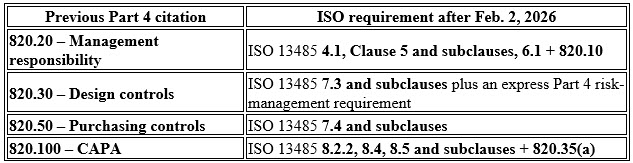
But the question is, should these specific clauses be addressed in a Part 4 Summary in a BLA or NDA? I did some AI searches to explore these questions.
I asked two fundamental questions, and my search tool returned a comprehensive response and multiple citations:
- How does the FDA’s QMSR with ISO 13485 specifically impact combination product regulations and practices in complying with 21 CFR Part cGMPs?
- Prepare a detailed “old Part 4 vs. new QMSR/ISO 13485” compliance matrix specifically for a prefilled syringe/autoinjector BLA or NDA and include what FDA might expect to see in the Part 4 compliance summary.
The search results gave me a concise understanding of the new expectations and also what might be a good idea to include in a Part 4 summary.
First, the results cited a July 21, 2026, Warning Letter to Koven Technologies, a device company, as an example. The letter lists multiple ISO 13485:2016 Clause 7.4.1 deficiencies for “failure to establish criteria for the evaluation and selection of suppliers.” The Linemaster Switch Corporation also received a May 27, 2026, Warning Letter regarding QMSR violations. So, ORA/CDRH is now inspecting for the QMSR.
My search also found a new FDA compliance policy guide: Compliance Program 7346.832M, Biological Drug Substance and Drug Product Pre-License and Pre-Approval Inspections, issued April 14, 2026, expressly states that combination products containing a biological product and device constituent part are subject to the device QMSR/ 21 CFR Part 820.
However, the Drugs@FDA database returned no search results on QMSR PAI inspections or the need to address the new ISO 13485 clauses for a combination product in a summary. This may be a topic worth searching for going forward using GenAI search tools.
The search results highlighted multiple distinctions between the previous Part 4 regulations and the additional ISO 13485 elements. The analysis that most often came up was to assess Risk Management activities under both ISO 13485 and Part 4.4(b)(1), which now incorporates Part 820.7 and references ISO 9000:2015(E) for Quality Management Systems.
My searches found many other details about differences and potential expectations, but chatbots can only go so far. With that limitation in mind, actual quality experts should review and validate against the source documents anything these bots say or recommend.
The Bottom Line For Part 4 Summaries In A BLA Or NDA
Clearly something has changed. Today, if I were to draft or review a Part 4 summary for a new BLA or NDA for a combination product, I would wholly address the QMSR expectations in the summary and would probably make that clear in the titled sub-sections; for example, 820.20 – Management responsibility, including ISO 13485 4.1, Clause 5 and subclauses, 6.1, and 820.10. FDA will likely look for a discussion of how the company has implemented the new QMSR’s ISO clauses for the combination product. Also, because deficiencies in the summary present a significant regulatory risk of Information Requests and PAI deficiencies, the topic does require regulatory oversight.
So, the precedent research in past BLA and NDA review memos provided above on Part 4 summaries should only be a starting point.
Again, this article emphasizes the need to incorporate GenAI searches into a company’s regulatory strategies and expected submission content. I encourage all Drug Delivery Leader readers to get savvy with AI searches and use these tools regularly.
About The Author
 Doug Mead is Principal Consultant and President of CP Pathways LLC, a combination product consultancy. He helps combination product companies with their regulatory strategies and works closely with delivery device teams and regulatory staff to prepare submissions in line with the latest regulatory expectations.