
Understanding FDA's 2026 Guidance For Generic Transdermal And Topical Delivery System Adhesion Assessments
By Tim Sandle, Ph.D.

For pharmaceutical manufacturers developing generic transdermal and topical delivery systems (TDS), adhesion should not be treated as a relatively minor physical characteristic of the finished product. Adhesion is simultaneously a material property, manufacturing outcome, clinical-performance characteristic, and patient-safety consideration. This is reflected in the July 2026 final FDA guidance, Assessing Adhesion With Transdermal and Topical Delivery Systems for ANDAs,1 which places adhesion firmly within the required demonstration of comparable product performance. The guidance replaces the April 2023 Revision 2 draft, and it applies specifically to studies supporting abbreviated new drug applications (ANDAs).
Adhesion sits at the interface between formulation science, pharmaceutical quality, clinical performance, and patient use. When a patch does not remain appropriately attached, the resulting loss of effective contact area can alter drug delivery. It additionally introduces uncertainty into bioequivalence (BE) and, following complete detachment, creates a secondary exposure hazard.
This article examines what the FDA now expects, where the scientific strengths and limitations of the approach lie, and what pharmaceutical developers should do differently.
Approaching Adhesion As A Critical Quality Attribute
A TDS is an unusual pharmaceutical dosage form because its performance depends upon sustained interaction between a manufactured product and a highly variable biological surface. Drug delivery is influenced partly by the surface area of the system that remains in contact with the skin. The FDA therefore expects the entire contact surface to remain consistently and uniformly adhered for the labeled wear period.
This importance has been documented in studies. Cilurzo and colleagues identified three particularly important adhesive characteristics: tack, describing establishment of a bond on brief contact; shear adhesion, reflecting resistance to flow or movement; and peel adhesion, representing the force necessary to remove an adhered patch. Their review also emphasized that formulation variables can alter these characteristics and that in vitro behavior does not straightforwardly predict performance on human skin.2 More recent literature continues to identify adhesion as a critical quality attribute. A 2025 review, for example, highlights continuing heterogeneity in methods used to evaluate patch adhesion and the need for better standardization.3
Hence, a formulation has to achieve a balance. Insufficient adhesion risks lifting or detachment; excessively aggressive adhesion can adversely affect removability, leave adhesive residue, or contribute to skin damage. The FDA's wider TDS development guidance connects adhesion failure with product performance and safety.4 Hence, successful development requires consideration of adhesion, drug delivery, skin compatibility, and manufacturability as interconnected properties.
FDA's Preferred Study Design
In terms of designing a study, the guidance indicates that changes to product design, active or inactive ingredients, backing membrane, or manufacturing process can affect adhesion. Alterations after approval may consequently require confirmation that adhesion-related quality attributes remain consistent. This is where clinical adhesion testing becomes closely connected with pharmaceutical development and change control. Changing an adhesive supplier, polymer grade, backing material, laminate construction, manufacturing condition, or patch geometry should not automatically be regarded as a purely CMC (chemistry, manufacturing, and controls) matter. The scientific question should always include whether the change could alter in-use adhesion.
The FDA expects the strength and size identified in the relevant product-specific guidance to be studied. Importantly, the agency acknowledges that larger patches can be particularly sensitive to detachment. A larger surface may encounter greater anatomical curvature and greater torsional or flexional stresses across the area of application. At the same time, a larger system can potentially allow adhesion differences to be assessed more precisely.
This underlines a wider development principle: Patch geometry is functionally important. Developers should therefore resist treating adhesive formulation, backing, patch dimensions, coat weight, system thickness, and manufacturing parameters as independent variables. Their interactions ultimately determine what happens when the system encounters skin movement, clothing, moisture, heat, and mechanical stress.
The European Medicines Agency (EMA) takes a similarly life-cycle-oriented quality perspective, addressing pharmaceutical development, manufacture, adhesion, drug release, and skin permeation rather than viewing these characteristics independently.5
Measuring Adhesion Throughout Wear
One of the strongest aspects of the FDA guidance is its emphasis upon time-resolved assessment. A single endpoint measurement potentially conceals important behavior. A patch might adhere extremely well initially but progressively lift during wear. The FDA therefore establishes example minimum assessment frequencies according to labeled duration:
- for a seven-day system, at least daily;
- for a 72-hour system, at least every 12 hours;
- for systems worn for 12 to 24 hours, at least every 4 hours; and
- for systems worn for less than 12 hours, at least hourly.
Assessments should normally be distributed uniformly over the wear period. This avoids overweighting early measurements where adhesion may be better. That requirement is statistically sensible. Sampling five times during the early phase of wear and only once near the end would produce a mean that poorly represents overall performance.
Understanding FDA's Five-Point Scale
For comparative assessment, the FDA retains a five-point ordinal adhesion scale, as per Table 1.
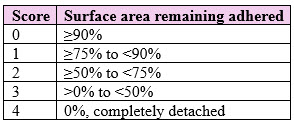
Table 1: Ordinal adhesion scale
The scale provides a practical standardized assessment applicable in clinical studies. However, it also exposes one of the scientific limitations of the methodology: It converts continuous physical behavior into relatively broad ordinal categories. A patch that is 89% adhered and one that is 76% adhered receive the same score despite a potentially meaningful difference in exposed surface area. This is further complicated by many studies relying simply upon visual assessment.
The FDA recognizes this limitation and states that investigators may use more sophisticated tools, such as trained visual assessment, dot-matrix templates, or alternative scales to estimate percentage adhesion. When an alternative scale is used, however, results should also be translated to the FDA five-point system, and the alternative approach should be adequately qualified. The final guidance recommends photographs to be collected at each assessment to support visual estimates.

Using The "Worst Score Carried Forward" Principle
An important methodological distinction is contained within the guidance. This concerns what investigators observe and what is subsequently analyzed. At every time point, the investigator records the actual adhesion observed, independently of previous scores. Observers should be blinded to the preceding evaluation. For the comparative analysis, however, the FDA recommends carrying forward the highest, meaning worst, adhesion score seen up to that point. For example, if actual observations are:
1, 2, 1, 3
the analysis becomes:
1, 2, 2, 3
Once a patch completely detaches, score 4 applies to all remaining scheduled assessments. The primary endpoint is the mean adhesion score across post-baseline assessment times.
When measurements are equally spaced, the scores are averaged. Where timing is unequal, the FDA describes a time-weighted mean in which individual scores are weighted according to the interval that they represent. To be acceptable, the test product must demonstrate noninferiority. The FDA specifies a noninferiority margin of 0.15 for the difference between mean adhesion scores using its five-point scale, with testing at a significance level of 0.05. The study should be powered at 80% or greater9.
The FDA also recommends the per-protocol population for the primary noninferiority analysis. This is not without difficulty since missing data and noncompliance can bias noninferiority studies toward concluding that products are similar. Consequently, the FDA calls for predefined approaches to missing data and sensitivity analyses where informative or unbalanced dropout could change the conclusion.
Real-World Stress Is Part Of The Test
Another strength of the guidance is that the FDA does not advocate protecting the patch from normal life; for systems with wear periods of 24 hours or longer, routine bathing or showering should be performed. The assessment should further embrace body movement, torsion, clothing contact, humidity, temperature changes, and water exposure. One challenge arises because human skin is variable. Curvature, movement, hydration, hair, sebum, and anatomical location each influence adhesive behavior. The FDA's general 2019 development guidance addresses peel adhesion, release-liner peel, shear, and related pharmaceutical-quality testing.4
In contrast, deliberate reapplication of detached areas, pressing the patch back onto the skin, and reinforcing it with overlays are not recommended. Investigators should also prevent artificial circumstances that inhibit detachment, such as constant pressure against a chair back.
Adhesion And Bioequivalence Can Be Combined
The FDA permits adhesion and pharmacokinetic (PK) bioequivalence to be evaluated within one study, provided the study is adequately established for both objectives and the PK population is prospectively defined. Published studies support this approach. A randomized crossover investigation of two buprenorphine patches evaluated both pharmacokinetic BE and adhesion noninferiority,6 while studies involving fentanyl systems have simultaneously examined pharmacokinetics, adhesion performance, residual drug, and safety.7
What Pharmaceutical Manufacturers Should Do
For manufacturers, the most useful interpretation of the 2026 guidance is to move adhesion assessment upstream. During development, companies should establish relationships between:
Material attributes → manufacturing parameters → adhesive properties → in-use adhesion → drug delivery.
This means characterizing adhesive chemistry and suppliers, laminate construction, coat weight and uniformity, backing materials, release liners, patch dimensions, tack, peel, shear, drug release, permeation, and stability. Adhesion should also be integrated into life-cycle change control.
Used patches also require consideration. The FDA recommends retention of systems removed or detached during combined in vivo adhesion/PK studies for residual-drug analysis. Its separate residual-drug guidance stresses that remaining drug can have implications for quality, efficacy, safety, and abuse potential.8
References
- U.S. Food and Drug Administration. Assessing Adhesion With Transdermal and Topical Delivery Systems for ANDAs: Guidance for Industry. Silver Spring (MD): FDA, Center for Drug Evaluation and Research; 2026: https://www.fda.gov/regulatory-information/search-fda-guidance-documents/assessing-adhesion-transdermal-and-topical-delivery-systems-andas
- Cilurzo F, Gennari CGM, Minghetti P. Adhesive properties: a critical issue in transdermal patch development. Expert Opin Drug Deliv. 2012;9(1):33-45.
- Sarmiento Giraldo JJ, Gonzalez Ospina J, Moncada F, Calad AM. Review on transdermal patches: optimization in drug administration. Colomb Med (Cali). 2025;56(4):e3007142.
- U.S. Food and Drug Administration. Transdermal and Topical Delivery Systems: Product Development and Quality Considerations. Draft Guidance for Industry. Silver Spring (MD): FDA; 2019: https://www.fda.gov/regulatory-information/search-fda-guidance-documents/transdermal-and-topical-delivery-systems-product-development-and-quality-considerations
- European Medicines Agency. Guideline on Quality of Transdermal Patches. EMA/CHMP/QWP/608924/2014. London: EMA; 2014: https://www.ema.europa.eu/en/documents/scientific-guideline/guideline-quality-transdermal-patches_en.pdf
- Davanço MG, Fortuny M, Scasso A, Meulman J, Costa F, da Silva TM, et al. Buprenorphine transdermal delivery system: bioequivalence assessment and adhesion performance of two patch formulations. Pharmaceutics. 2024;16(10):1249.
- Lorch U, Pierscionek T, Freier A, Spencer CS, Täubel J. Safety, tolerability, and dose proportionality of a novel transdermal fentanyl matrix patch and bioequivalence with a matrix fentanyl patch: two phase 1 randomized crossover studies. Clin Pharmacol Drug Dev. 2021;10(3):260-271.
- U.S. Food and Drug Administration. Residual Drug in Transdermal and Related Drug Delivery Systems: Guidance for Industry. Silver Spring (MD): FDA; 2011: https://www.fda.gov/regulatory-information/search-fda-guidance-documents/residual-drug-transdermal-and-related-drug-delivery-systems
- U.S. Food and Drug Administration. Bioequivalence Statistics for Adhesion and Irritation Studies. FDA webinar: A Deep Dive: FDA Draft Guidance on Statistical Approaches to Establishing Bioequivalence. March 14, 2023: https://www.fda.gov/media/167461/download?attachment
About The Author:
 Tim Sandle, Ph.D., is a pharmaceutical professional with wide experience in microbiology and quality assurance. He is the author of more than 30 books relating to pharmaceuticals, healthcare, and life sciences, as well as over 170 peer-reviewed papers and some 500 technical articles. Sandle has presented at over 200 events and he currently works at Bio Products Laboratory Ltd. (BPL), and he is a visiting professor at the University of Manchester and University College London, as well as a consultant to the pharmaceutical industry. Visit his microbiology website at https://www.pharmamicroresources.com.