
When The Adhesive Becomes The Drug Delivery System
By Narumi Nozawa, pharmacist and formulator, Majestic Cosme

The European Medicines Agency (EMA) guideline on the quality of transdermal patches is blunt on one point: "Crystal formation is a quality deficiency likely to adversely influence the in vivo performance of the patch."1
The FDA starts from a different default. Its draft guidance on transdermal and topical delivery systems says crystallization of the drug substance should generally be avoided, and that where it does occur, studies should assess the impact on in vivo performance and adhesion.2
Most development teams read those guidances as instructions to prevent crystals. Teams run stability studies, look for haze under polarized light, and treat any crystal they find as a failure.
The EMA’s guideline contains an exception that is easy to miss. Patches should show no signs of crystallization at release, except in suspension formulations where the active substance is intentionally dispersed. The guideline also names "the target physical state of the drug substance, e.g., solute, suspension, and the degree of saturation or supersaturation" as critical quality attributes, to be justified in terms of efficacy and safety and supported by evidence of how that state is achieved during manufacture and maintained across shelf life.1 The regulator is not saying crystals are forbidden. It is saying you must decide what physical state the drug occupies, defend that decision, and prove you can hold it.
That distinction separates two outcomes that share the same underlying physics. In one marketed patch, drug crystals sustain delivery for a full day by design. In another, crystals appeared unexpectedly, covered as much as 40% of the patch surface, and left the product unavailable in the United States from 2008 until 2012.3,4 The difference was not whether crystals formed. It was whether anyone had specified the solid state and could control it.
The Adhesive Is Not Packaging
In a drug-in-adhesive patch, the pressure-sensitive adhesive (PSA) does four jobs at once. It holds the system on the skin. It is the matrix in which the drug sits, dissolves, or disperses. It governs the rate at which drug partitions toward the skin surface. And it is the physicochemical environment that determines whether the drug stays in the physical state you intended for the next two years.
How much the adhesive chemistry matters is easy to underestimate. In a controlled comparison of three adhesive families carrying the same drug, lidocaine saturation concentration was 2.5% w/w in silicone, 3.5% w/w in polyisobutylene, and 25% w/w in acrylate.5 In one molecule, that’s an order-of-magnitude difference in how much each matrix will hold before crystals appear.
Loading capacity does not translate into delivery. In that same work, the silicone system released the highest proportion of its drug load over 72 hours despite carrying the least drug, and the authors concluded that release and permeation behavior in each specific adhesive must be evaluated during early development rather than inferred from solubility data alone.5
The adhesive also determines how crystals behave once they form. Raman mapping of tulobuterol transdermal tapes found distinct crystal growth patterns in rubber matrices compared with acrylic matrices and detected crystals in commercial product.6 The same drug, in two adhesive chemistries, crystallizes differently.
The practical consequence is that adhesive selection constrains everything downstream and belongs early in development, decided on combined evidence from loading, crystallization behavior, release, permeation, and adhesion rather than on solubility numbers by themselves.
Saturation As A Design Variable
Skin flux responds to the thermodynamic activity of the drug in the vehicle, not simply to how much drug the vehicle contains. A solution held at saturation in equilibrium with excess solid sits at maximum activity for that vehicle and stays there as long as solid remains. That is the physical basis for putting crystals into a patch on purpose.
One Japanese transdermal product applies the principle directly. The tulobuterol patch is a matrix system containing both crystallized and molecularly dissolved drug in the adhesive layer. Dissolved drug is absorbed through the skin, and as that fraction depletes, crystals dissociate to replenish it.7 The crystals act as the reservoir, holding the dissolved fraction near saturation rather than crossing the skin themselves.
The resulting profile is engineered rather than incidental. A 2 mg patch shows an absorption lag of roughly 4 hours and peaks at 9 to 12 hours, reaching approximately 1.4 ng/mL against a target effective serum concentration near 1.0 ng/mL, with around 90% of the drug absorbed within 24 hours.7 The design target was the early-morning deterioration in pulmonary function that affects a large share of asthma patients: applied at bedtime, the system peaks when the patient needs it.
Two features are worth noting. In this system, release control comes from the physical state of the drug within the adhesive rather than from a separate rate-controlling membrane. And the profile is shaped toward a pharmacological timing requirement rather than toward the flattest possible release.
The Same Physics, Unplanned
Rotigotine, marketed as the transdermal patch Neupro, is the counter-case. It was formulated as amorphous drug dispersed in a polymer matrix, and it had been known in a single polymorphic form since 1985. Polymorph screening performed in the early 2000s did not find another.4
In 2008, crystals appeared. Regulators described them as resembling snowflakes and covering up to 40% of the patch surface. A batch recall followed in Europe.4 The EMA required storage between 2 degrees C and 8 degrees C to limit further crystallization, stated at the time that the effect on efficacy remained unclear, and initiated a phased replacement of all European Union batches with product manufactured under full cold chain conditions, staged deliberately to avoid a shortage.3 The product did not return to the United States until 2012.4
The root cause was characterized later. A second polymorph, Form II, has a solubility more than eight times lower than Form I. Polymorph pairs usually differ in solubility by less than a factor of two, which makes this an unusually severe case. Computational crystal structure prediction subsequently reproduced Form II and predicted a third form, matching experiment closely: a calculated enthalpy difference of 7.6 kJ/mol against a measured 7.5 and a calculated solubility ratio of 8.3 against an experimental 8.4 determined in ethanol at room temperature.4
The lesson is not that crystals destroy patches. It is that a formulation can depend on an amorphous dispersion that looks stable for two decades and still be vulnerable to a more stable polymorph that no screening program has found yet.
Four Designs, Four Risk Profiles
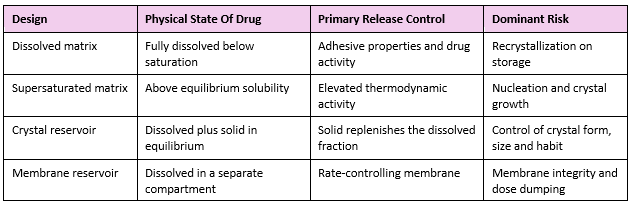
Choosing between these four is the decision that sets the entire development program. The first three all live inside the adhesive, which is why adhesive selection is not a late-stage detail.
What To Establish Before You Commit
If you are considering a design in which solid drug is present by intent, or if you are relying on the drug remaining dissolved, settle the following early.
- Measure saturation solubility in the actual adhesive, not in a surrogate solvent and not by analogy to a similar polymer. Values are adhesive-specific and can be very small: levonorgestrel saturation in one acrylate adhesive was estimated at 0.09% w/w.8 The formulation window may be far narrower than you assume.
- Declare the intended physical state and justify it. The EMA treats physical state and degree of saturation or supersaturation as critical quality attributes requiring justification on efficacy and safety grounds, and expects evidence of how the target state is achieved in manufacture and held across shelf life.1 Justifying the state you want is not the same as demonstrating you can reach it and keep it. Decide this deliberately at the start rather than discovering it at month nine of stability.
- Screen for polymorphs assuming you have missed one. Rotigotine had a single known form for more than 20 years, and experimental screening did not find Form II.4 Computational crystal structure prediction has since shown it can recover forms that experimental screening missed, and it is worth running alongside conventional screening, not as a replacement for it, for any drug entering a solid-state-sensitive product.
- Stress the product the way manufacturing will. Die-cutting has been shown to accelerate crystal development compared with uncut sheets.8 Testing cast films tells you less than testing finished cut patches.
- Use nondestructive solid-state analytics. Near-infrared (NIR) spectroscopy with imaging has been applied to crystal reservoir tapes specifically,9 and microscopic laser Raman mapping has been used to map tulobuterol distribution in both model and commercial transdermal tapes,6 in each case without destroying the sample. Differential scanning calorimetry (DSC), X-ray powder diffraction (XRPD),10 and polarized light microscopy5 remain appropriate, but methods that require destructive sample preparation force you to use a different unit at every time point rather than following one through storage.
- Track mechanical properties, not only assay and impurities. Recrystallization changes the matrix itself. A case study from U.S. FDA researchers on a testosterone system found that recrystallization affected the mechanical and rheological characteristics of the product.11 A patch that still meets chemical assay requirements but no longer adheres has failed.
If you are inhibiting crystallization rather than embracing it, screen the inhibitors in the actual adhesive system rather than assuming one will transfer. Polyvinylpyrrolidone, polyethylene glycol, poloxamers, and methacrylate copolymers are all used for this purpose.8,10 Be aware that assessment methods can disagree. In one study of levonorgestrel in an acrylate adhesive, differential scanning calorimetry identified poloxamer as the strongest candidate while slide-crystallization testing favored polyvinylpyrrolidone.8 A single screening technique should not decide the formulation.

Where This Approach Fits, And Where It Does Not
A suspension design is not a general-purpose answer. It suits drugs with a therapeutic dose the adhesive can carry without compromising adhesion, adequate solubility in the chosen adhesive, a well-characterized polymorph landscape, and a target profile that benefits from sustained delivery across many hours.
It is a poor choice where rapid onset matters. The 4-hour lag in the tulobuterol system is a feature for a bedtime-applied product aimed at early-morning symptoms and a defect for anything requiring fast systemic exposure. It is also a poor choice for drugs with multiple accessible polymorphs of substantially different solubility, because the reservoir you designed can convert into a reservoir you did not.
Choose it with the full cost in view. Committing to a suspension turns a stability program into a solid-state control program. You become responsible for the identity, form, size, and habit of the solid phase across shelf life rather than simply demonstrating its absence. That is more analytical work and more manufacturing control, not less.
Plan for the risk that does not go away. A characterized solid phase is not a closed question, because a new form can still appear late, as it did with rotigotine after two decades. Build solid-state surveillance into the control strategy rather than treating approval as the end point: nondestructive imaging on retained samples, with orthogonal diffraction or thermal analysis triggered if anything shifts. That ongoing burden is part of the real cost of the design.
The Decision That Comes First
The adhesive is not the component that keeps the patch on the patient. It is the formulation, and the physical state of the drug inside it is a design choice whether or not anyone makes it deliberately. Decide which state the drug should occupy, prove you can hold it there for the life of the product, and build the analytical program that will tell you when you cannot.
That decision belongs before the stability program, not after it.
References:
- European Medicines Agency. Guideline on quality of transdermal patches. EMA/CHMP/QWP/608924/2014. Adopted December 16, 2014. https://www.ema.europa.eu/en/documents/scientific-guideline/guideline-quality-transdermal-patches_en.pdf
- U.S. Food and Drug Administration, Center for Drug Evaluation and Research. Transdermal and Topical Delivery Systems: Product Development and Quality Considerations. Draft guidance for industry. November 2019. Docket FDA-2019-D-4447. https://www.fda.gov/media/132674/download
- European Medicines Agency. EMEA recommends changes in the storage conditions for Neupro (rotigotine). June 4, 2008. https://www.ema.europa.eu/en/news/emea-recommends-changes-storage-conditions-neupro-rotigotine
- Mortazavi M, Hoja J, Aerts L, Quéré L, van de Streek J, Neumann MA, Tkatchenko A. Computational polymorph screening reveals late-appearing and poorly-soluble form of rotigotine. Communications Chemistry. 2019;2:70. doi:10.1038/s42004-019-0171-y
- Dasht Bozorg B, Banga AK. Effect of different pressure-sensitive adhesives on performance parameters of matrix-type transdermal delivery systems. Pharmaceutics. 2020;12(3):209. doi:10.3390/pharmaceutics12030209
- Sakamoto T, Matsubara T, Sasakura D, Takada Y, Fujimaki Y, Aida K, Miura T, Terahara T, Higo N, Kawanishi T, Hiyama Y. Chemical mapping of tulobuterol in transdermal tapes using microscopic laser Raman spectroscopy. Die Pharmazie. 2009;64(3):166–171. doi:10.1691/ph.2008.8217
- Ichikawa T, Sugiura H. Long-term safety, efficacy, and patient acceptability of the tulobuterol patch. Research and Reports in Transdermal Drug Delivery. 2013;2:9–18. doi:10.2147/RRTD.S34031
- Jain P, Banga AK. Induction and inhibition of crystallization in drug-in-adhesive-type transdermal patches. Pharmaceutical Research. 2013;30(2):562–571. doi:10.1007/s11095-012-0901-7
- Sakamoto T, Fujimaki Y, Takada Y, Aida K, Terahara T, Kawanishi T, Hiyama Y. Non-destructive analysis of tulobuterol crystal reservoir-type transdermal tapes using near infrared spectroscopy and imaging. Journal of Pharmaceutical and Biomedical Analysis. 2013;74:14–21. doi:10.1016/j.jpba.2012.10.003
- Sharma PK, Panda A, Pradhan A, Zhang J, Thakkar R, Whang CH, Repka MA, Murthy SN. Solid-state stability issues of drugs in transdermal patch formulations. AAPS PharmSciTech. 2018;19(1):27–35. doi:10.1208/s12249-017-0865-3
- Mohamed L, Kamal N, Elfakhri K, Willett D, Wokovich A, Strasinger C, Cruz C, Raney S, Ashraf M, Zidan A. Drug recrystallization in drug-in-adhesive transdermal delivery system: a case study of deteriorating the mechanical and rheological characteristics of testosterone TDS. International Journal of Pharmaceutics. 2020;578:119132. doi:10.1016/j.ijpharm.2020.119132
About The Author:
 Narumi Nozawa is a licensed pharmacist and formulator at Majestic Cosme in Japan, where she works in product development and research. Her focus is topical formulation, with particular attention to the physical stability of active ingredients and the analytical methods used to characterize them. Her day-to-day work includes stability testing and evaluating how formulation and processing choices affect the behavior of active ingredients across a product's shelf life. She holds a pharmacist license in Japan, and has a particular interest in where cosmetic and pharmaceutical formulation science overlap, especially in the delivery of peptide and protein-based actives through the skin.